Districts and neighbourhoods in Katowice
Katowice is divided administratively into 22 districts grouped into five clusters: the city-centre cluster, northern, western, eastern, and southern. The further south you go, the more greenery, woodland, and detached houses you find; the centre and northern districts offer denser development, tenements, and blocks close to transport hubs.
Śródmieście
The tight city centre: tenements from the turn of the nineteenth and twentieth centuries (ranging from neo-Renaissance to Art Nouveau), department stores, and office buildings around the Rynek and ul. Mariacka. The main regional tram lines converge here, Katowice Główne railway station and a shopping centre are on the doorstep, and the Strefa Kultury cultural quarter — with the Spodek arena, NOSPR concert hall, and the Silesian Museum — is close by.
Suitsthose who value a car-free lifestyle and proximity to work and culture, and can accept the noise and higher prices
Koszutka
A residential district just north of the centre, largely built up with a Socialist Realist estate from the 1950s — the largest of its kind in Katowice — alongside tenements and blocks. It borders the Strefa Kultury cultural quarter and the Spodek, has good tram connections, and is within easy walking distance of the city centre.
Suitsthose who want to live near the centre but in a quieter, fully urban setting
Bogucice
An old district with roots in a medieval village, today a mix of listed tenements, former workers' colonies, block estates (including Ścigały, Kukuczki, and Wajdy), and houses in the Alpy area. It borders the Strefa Kultury cultural quarter (Spodek, NOSPR, Silesian Museum) to the east and a hospital on ul. Józefowska; a considerable number of new-build developments are currently under way here.
Suitsthose looking for a home near the centre across a range of budgets, from tenements to new-build blocks
Załęże
One of the oldest, working-class and industrial parts of the city, to the west of the centre, which grew up around the Baildon steelworks and the Kleofas colliery. The predominant building stock is older multi-family housing: century-old tenements and brick workers' cottages with courtyards; the central part has undergone a regeneration programme. A railway line and the main arterial road (ul. Gliwicka) run through the district.
Suitsthose seeking cheaper flats close to the centre who are comfortable with a post-industrial, still partly refurbished character
Osiedle Tysiąclecia
A Modernist large-panel prefab estate built from the 1960s onwards to a design by Buszko and Franta, recognisable by its tall tower blocks (known locally as the 'corncobs' and 'stars'). Fully self-contained: schools, shops, plenty of greenery between the blocks, and tram services into the city centre.
Suitsthose who appreciate a well-established, well-equipped block layout with green space and tram connections to the centre
Osiedle Witosa
An estate in the far north-western corner of the city, consisting largely of large-panel prefab blocks from the 1970s with its own infrastructure (a church, schools, shops, and a community centre). It borders the Las Kochłowicki forest to the south and the Chorzów-Batory district to the west.
Suitsfamilies looking for affordable flats in a block estate with woodland right on the doorstep
Wełnowiec-Józefowiec
Formerly an industrial district in the north, today one of the most active areas for new construction in Katowice — numerous developer schemes (including ATAL and Murapol) are rising on former industrial land. Close to Park Śląski and Park Wełnowiecki, with convenient access to the city centre.
Suitsthose buying a new-build flat from a developer, close to the centre and large parks
Dąb
A small district between Wełnowiec, Załęże, and Park Śląski, combining older housing stock and tenements with newer estates and retail units along the main roads. It adjoins green areas and has good connections towards Chorzów and the city centre.
Suitsthose looking for a flat on a main arterial route with Park Śląski close by
Brynów część wschodnia-Osiedle Zgrzebnioka
A peaceful, predominantly villa-and-detached-house area south of the centre, with the intimate Osiedle Zgrzebnioka estate. It borders Park Kościuszki (approx. 72 ha, the former Park Południowy) and the Dolina Trzech Stawów valley, offering plenty of green space while the city centre remains close.
Suitsthose who value quiet surroundings, greenery, and low-rise development with good access to the centre
Ligota-Panewniki
A large, varied district in the west combining residential, commercial, and educational functions; alongside older Ligota there is a block estate (Nowa Ligota) and detached housing. The key Katowice Ligota railway station provides fast links into the urban rail network, while Panewniki is known for its Franciscan basilica and monastery, and the nearby forests.
Suitsthose who prioritise rail commuting and want a mix of blocks and houses with green surroundings
Piotrowice-Ochojec
A large southern district with an urban character, offering a mix of blocks, tenements, and detached houses alongside a well-developed retail and service offer. It has its own railway stops (Katowice Piotrowice and the new Katowice Ochojec), good transport links, a hospital in Ochojec, and green areas along the Kłodnica river.
Suitsthose looking for a wide choice of flats with good services and rail access in the southern part of the city
Kostuchna
A quiet southern district dominated by low-density detached housing, surrounded by woodland. To the east there is a network of forest walking and cycling paths; to the south a ski slope with a lift. The new Katowice Kostuchna railway stop has improved access to the centre.
Suitsfamilies wanting a house or peaceful flat with woodland and quiet on the doorstep, at the cost of a longer journey into the centre
OchojecPiotrowice-Ochojec
The smaller, formerly rural part of the southern district, with detached houses and estates bordering the valleys and green areas along the Kłodnica river. A city hospital is located here, and the new Katowice Ochojec stop has improved rail access.
Suitsthose who value an intimate, low-rise setting with greenery and a railway connection
Giszowiec
A historic garden estate built in 1907–1910 (designed by the Zillmann brothers) for miners of the Giesche colliery, characterised by low cottages with gardens; part of the original stock was replaced in the 1970s by large-panel prefab blocks. The central area is encircled by the Lasy Murckowskie and the Katowice Forest Park, offering extensive walking and cycling terrain.
Suitsthose who appreciate a heritage atmosphere and proximity to woodland, and are comfortable with a longer commute to the centre
NikiszowiecJanów-Nikiszowiec
A listed workers' estate from 1908–1918 (designed by the Zillmann brothers) for employees of the Giesche colliery, with compact, red-brick development arranged around plac Wyzwolenia; it is entered in the register of historic monuments and designated a Monument of History. Flats in the atmospheric workers' cottages, with shops and services within the estate, though further from the centre.
Suitsthose seeking a home with a unique, heritage character in a highly regarded neighbourhood
Szopienice-Burowiec
An eastern, historically industrial district along the Rawa river, roughly 5–6 km from the centre, with low-rise older building stock (tenements, workers' cottages, and workers' colonies) and a scattering of blocks from the 1970s Morawa estate. In the north-eastern part lies a complex of ponds including Morawa — the largest open water in Katowice — with recreational areas along the waterfront.
Suitsthose looking for cheaper flats in a post-industrial district with access to water and recreational space
Zawodzie
A district east of the centre, along the Rawa river, blending older building stock with blocks and new developer schemes on former industrial land. The campus of the University of Economics (with its rectorate in the former Zawodzie town hall) is situated here; tram stops and a short journey to the city centre make it well connected.
Suitsstudents and buy-to-let investors who value proximity to the university and the city centre
Osiedle Paderewskiego-Muchowiec
A tower-block estate from the 1970s and 80s (mainly 11-storey buildings) with a full range of retail and services, directly adjacent to the city centre. Right next door is the extensive Katowice Forest Park, the Dolina Trzech Stawów valley with its bathing lake, and Katowice-Muchowiec sports airfield — a large recreational area on the edge of the city.
Suitsthose who want a flat in a block right by the centre, with a park and lakes on the doorstep
Murcki
The southernmost residential district, a former mining settlement separated from the rest of the city by a wide belt of woodland. The housing stock comprises workers' cottages, houses, and estates; nearby is the Las Murckowski nature reserve with ancient beech trees, and a new railway stop has improved connections to the centre.
Suitsthose who want woodland and quiet as part of daily life, and are happy to accept a noticeable distance from the centre
Podlesie
A peaceful southern district with a predominance of detached houses and new estates, surrounded by green areas. It has a suburban, intimate character and its own railway stop (Katowice Podlesie Saska), which improves access to the city centre.
Suitsfamilies looking for a house in a quiet, suburban setting with a railway connection to the centre
These descriptions are informational — the best district depends on your criteria. Score the district match on the map →
How to choose a location
The question is whether an address fits your day, not only where it's cheaper. mScanner helps analyse a location in Katowice through concrete criteria, not through a district's general reputation.
First it is worth deciding what matters most to you: the commute, quiet, greenery, schools, services, transport or quick access to the centre.
Local differences in Katowice
When choosing a flat, compare areas such as Śródmieście, Koszutka, Bogucice, Załęże, Osiedle Tysiąclecia, Osiedle Witosa, Brynów, Ligota, Piotrowice and Ochojec. Each of them can look different on the commute, services, greenery, noise and price.
Katowice is worth comparing with its GZM neighbours: Chorzów, Sosnowiec, Tychy, Mysłowice, Siemianowice Śląskie and Mikołów. Neighbouring towns can be cheaper, but access to trams, rail and the main roads is what counts.
Commutes
A commute is best measured to specific places, not just to the centre. For one person the best address is near a stop, for another near a good motorway access or a school.
In the GZM metropolis many people travel between Katowice, Chorzów, Sosnowiec or Tychy — two similar addresses can mean different travel times depending on access to rail, trams and the main roads.
Greenery and recreation
Proximity to greenery affects daily life, but the distance to a park alone is not enough. It is worth checking the real access to walking, waterside and recreation areas.
Nearby services
Shops, nurseries, schools, clinics and everyday service points can save more time than a few minutes saved on the commute to the centre.
Noise and surroundings
Noise, busy streets, proximity to large developments and the character of the buildings are worth assessing before you decide on a flat — whether you are buying or renting.
The zoning plan (MPZP) and the area plan
The local zoning plan (MPZP) and the urban surroundings help you understand what might be built nearby and whether the current view from the window is a lasting feature of the location.
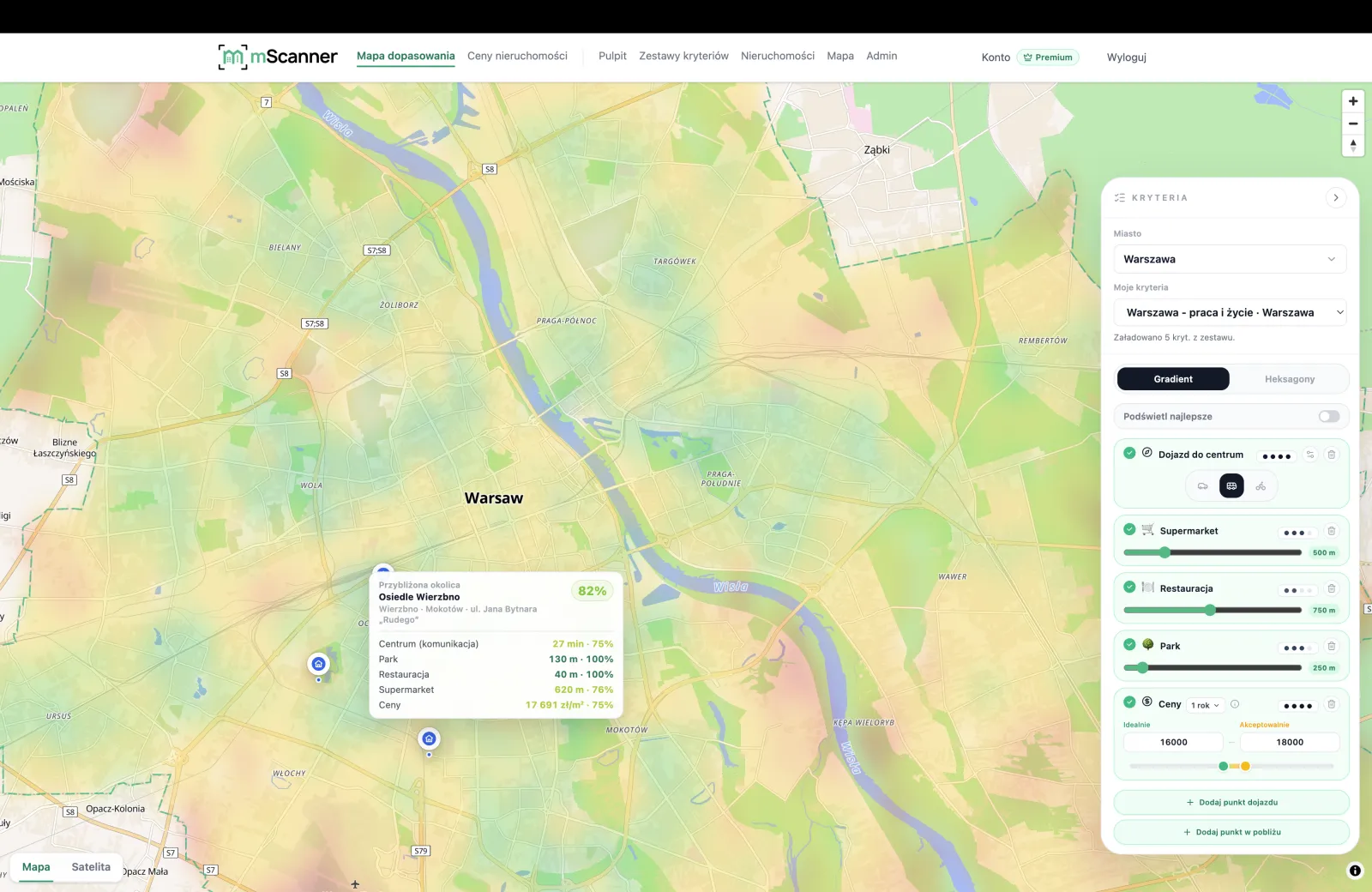
How to use the mScanner city heatmap
In mScanner you can pick location criteria and check which areas best fit your needs. It is then worth setting the result against the price and the report for a specific address.
Frequently asked questions
How does mScanner help choose where to live in Katowice?
It helps compare specific addresses by commutes, services, greenery, noise, the zoning plan, prices and your own location criteria.
Does mScanner replace viewing a flat?
No. mScanner helps organise the most important questions before deciding, but viewings, documents and professional checks are still needed.
Is it worth comparing several flats at once?
Yes. Comparing several saved flats helps you see whether you are paying extra for a real location advantage or just for the wording of the listing.
Which districts in Katowice are the greenest?
It depends on how close to a park, forest or water you want to live and which way you travel day to day. Instead of a generic ranking, the mScanner city heatmap scores areas by real access to greenery — set that criterion and see which addresses come out best for you.
Where in Katowice are the cheaper districts?
The lowest price per m² is not always the best choice — a cheap address can be far from work or services. The price map shows the price distribution, and the city heatmap sets price against the commute and surroundings, so you do not save at the cost of your daily commute.
Where to live in Katowice for a good commute to work or the centre?
Start with the question: by car or transit, and at what hours? The city heatmap computes the travel time from each area to the points you choose — work, school or the centre — so instead of guessing you see which districts give a fast commute on your routes.
How do I find a quiet, calm district in Katowice?
Quiet depends on more than the absence of a busy street — proximity to large developments and the building plan matter too. The city heatmap factors in a noise criterion, and the address report shows the zoning plan and surroundings, so you can check whether the calm is lasting.
Which district in Katowice is best for a family, a single person or a student?
There is no single best district — a family values schools, quiet and greenery, a single person values proximity to the centre and transport, and a student values rent and the commute to campus. In the city heatmap you set the weights of these criteria and get a result tailored to your profile.