Districts and neighbourhoods in Gdynia
Gdynia spreads in distinct bands: from the seaside, villa-lined modernist south (Orłowo, Kamienna Góra), through the modernist city centre and its adjoining districts, to the large-panel prefab estates of the west and the hills (Witomino, Karwiny, Dąbrowa), and the working-class, port-facing north on the Kępa Oksywska headland (Obłuże, Pogórze). When choosing a neighbourhood, it is worth considering distance from the centre and the sea, the type of housing stock (tenements / large-panel prefab blocks / new estates / houses), and access to SKM and PKM rail.
Śródmieście
The tight city centre on the Bay of Gdańsk, dominated by modernist tenements from the 1920s and 1930s (Świętojańska, 10 Lutego, Skwer Kościuszki), listed as a national historic monument. The area is home to the port, the South Pier with the Dar Pomorza tall ship, the Maritime Station, Gdynia Główna railway station, and a dense concentration of shops and restaurants. High-rise Sea Towers apartments and marinas line the waterfront.
Suitsthose who value living in the centre close to the sea and accept higher prices and urban noise
Kamienna Góra
A small district perched on a glacial moraine hill immediately beside the city centre and the beach, built up with pre-war modernist villas and tenements that are listed in the heritage register. At the summit there is a viewpoint terrace with a cross and a park named after Maria and Lech Kaczyński; a funicular railway climbs the hill. The Gdynia City Museum sits at the foot of the slope.
Suitsthose seeking a prestigious, villa-lined neighbourhood within walking distance of the centre and the sea
Orłowo
A seaside, villa-studded district in the south, bordering Sopot, with the Orłowo cliff, its beach, a wooden pier dating from 1934, and the mouth of the Kacza river. The built form is low-rise villas and intimate higher-standard estates; the western part contains the Kolibki manor and park complex and the Summer Theatre. Served by its own SKM station at Gdynia Orłowo.
Suitsthose who value a quieter, seaside atmosphere and villa-style housing and are willing to pay a premium for it
Redłowo
A coastal district between the city centre and Orłowo, featuring the Kępa Redłowska nature reserve, cliffs, a beach, and Polanka Redłowska. The housing stock is mixed: sea-view tower blocks stand alongside detached houses, while the business zone contains the Pomeranian Science and Technology Park and office buildings. The Szpital Morski hospital and the Klif shopping centre on al. Zwycięstwa are nearby; rail connections are provided by SKM and the PKM Gdynia Stadion stop.
Suitsthose who want access to greenery and the sea combined with proximity to the centre and places of work
Wzgórze Św. Maksymiliana
A district between the city centre and Redłowo, rising above the bay, with a mixed townscape of tenements, villas, and blocks, and the seaside Feliks Nowowiejski Boulevard. The main axis is aleja Zwycięstwa, lined with the Musical Theatre, a Franciscan monastery, and secondary schools; the Riviera shopping centre (ul. K. Górskiego) is also in the district. Served by an SKM station.
Suitsthose who value proximity to the centre, the boulevard, and local amenities within a varied built environment
Działki Leśne
A pre-war district immediately behind Gdynia Główna station, with a large number of 1930s modernist tenements on streets named after Polish regions and cities. The built form is predominantly dense, multi-family housing on undulating ground; a prominent landmark is the Jesuit church, monastery, and school complex on ul. Tatrzańska.
Suitsthose who want to live within walking distance of the station and centre in an atmosphere of interwar architecture
Grabówek
A district west of the city centre, stretching along the important ul. Morska artery, with mixed housing and a portion of the Tri-City Landscape Park. The Maritime University is located here, as is the Church of the Holy Family; the Kwiatkowski Flyover linking the port to the bypass passes through the district. The area is served by the SKM stops at Gdynia Stocznia and Gdynia Główna.
Suitsthose looking for an affordable neighbourhood close to the centre with good public transport links
Leszczynki
A working-class district running along ul. Morska, with a former railway colony at its core; the northern part is dominated by blocks of flats while the south contains detached houses. The Kwiatkowski Flyover crosses the area, and — despite the name — the SKM Gdynia Grabówek station actually serves this district. A trolleybus depot is located at the Zakręt do Oksywia junction.
Suitsthose looking for cheaper housing with fast SKM rail and trolleybus connections
Chylonia
One of the most populous districts in the west, with a mixed built environment: large-panel prefab blocks from the 1960s and 1970s, early-twentieth-century tenements along ul. Chylońska, and detached houses. The service hub clusters around the junction of Morska and Chylońska; the district has an SKM station at Gdynia Chylonia and the historic St Nicholas church. The north-eastern edge borders industrial and railway land.
Suitsthose looking for cheaper housing with a dense network of local services and good rail connections
Cisowa
The most north-westerly district, bordering Rumia, bisected by the Cisowska stream. Tower blocks built in the 1970s for shipyard and port workers' families dominate along ul. Morska and Chylońska; the southern fringe takes in part of the Tri-City Landscape Park. The district has an SKM station at Gdynia Cisowa, bus and trolleybus interchange points, and a warehouse and industrial zone north of the railway tracks.
Suitsthose seeking affordable housing with a forest nearby and SKM connections, and who do not mind the distance from the centre
Witomino
A hilly district surrounded by forests of the Tri-City Landscape Park, formed in 2019 from the merger of Witomino-Leśniczówka and Witomino-Radiostacja. Housing consists mainly of block estates on the elevated terrain; there is no local rail, and getting around relies on a number of bus routes. It is closer to the centre than the western prefab estates, but cut off from the SKM network.
Suitsthose who value proximity to the forest and lower prices and are happy to commute by bus
Karwiny
A dormitory district in the south-west, roughly 8 km from the centre, on the edge of the Tri-City Landscape Park. It is dominated by four-storey large-panel prefab blocks from the 1980s and a dozen or so ten- to eleven-storey tower blocks, divided into Karwiny I, II, and III. Since 2015 the PKM Gdynia Karwiny station has served the district at the boundary with Mały and Wielki Kack.
Suitsthose seeking a quiet estate close to the forest with PKM rail access and who accept the distance from the centre
Dąbrowa
One of the newer residential districts in the west, bordering Chwarzno-Wiczlino, Karwiny, and Wielki Kack, with the Kacza river forming its northern boundary. The built form combines blocks of flats and detached houses among generous areas of woodland and reservoirs. The Donas Hill (approximately 206 m) rises in the area, topped with a mast and viewing platform; access is primarily by bus.
Suitsfamilies looking for newer housing surrounded by greenery who are willing to commute to the centre
Chwarzno-Wiczlino
Gdynia's largest district by area, on the western outskirts, enclosed by forests of the Tri-City Landscape Park. It consists mainly of new developer estates (including projects by Hossa) and detached houses — a typically suburban, still-developing character. It is the furthest from the centre and has no rail link; getting around depends on the car and bus services.
Suitsthose looking for new-build housing and houses among forests who accept the distance from the centre and limited public transport
Obłuże
A district on the Kępa Oksywska headland in the northern part of the city, with W-70 and OWT-67 prefab-panel blocks in the southern part and extensive allotment gardens to the north. Historically and currently tied to the military and the port — it carries the only overland access road to Oksywie and Babie Doły, as well as the start of Trasa Kwiatkowskiego leading to the S6 dual-carriageway. No SKM connection; access by bus.
Suitsthose looking for cheaper housing in the north, including people connected with the navy, and who accept the commute to the centre
Pogórze
A district on the southern edge of the Kępa Oksywska headland, divided into Pogórze Górne and Pogórze Dolne, set on elevated ground overlooking the bay. Housing consists of blocks and newer estates, in the vicinity of the military north of the city; from here a ridge road leads towards Rewa and the beaches in the Kosakowo municipality. The district borders Rumia and is reached primarily by bus.
Suitsthose who value bay views and proximity to beaches near Gdynia and accept the distance from the centre
Oksywie
The historically oldest part of Gdynia, on the Kępa Oksywska headland above the bay, strongly associated with the Polish Navy — it is home to the Naval Port and the Naval Cemetery. The built form is mixed: older blocks, detached houses, and military land; overland access is possible only via Obłuże. The setting is coastal, but the district is off to one side of the rest of the city and has no rail connection.
Suitsthose connected with the navy who value a seaside, secluded location and accept the commute involved
These descriptions are informational — the best district depends on your criteria. Score the district match on the map →
How to choose a location
The question is whether an address fits your day, not only where it's cheaper. mScanner helps analyse a location in Gdynia through concrete criteria, not through a district's general reputation.
First it is worth deciding what matters most to you: the commute, quiet, greenery, schools, services, transport or quick access to the centre.
Local differences in Gdynia
When choosing a flat, compare areas such as Orłowo, Redłowo, Śródmieście, Działki Leśne, Witomino, Chwarzno-Wiczlino, Karwiny, Dąbrowa, Obłuże and Pogórze. Each of them can look different on the commute, services, greenery, noise and price.
When looking for a flat in Gdynia, it is worth looking at the whole Tricity. An offer that looks good on price can read differently if you commute to Gdańsk, Sopot or further along the SKM every day.
Commutes
A commute is best measured to specific places, not just to the centre. For one person the best address is near a stop, for another near a good motorway access or a school.
A flat closer to the SKM and services can work completely differently from a similar offer further from the centre, even if the price per square metre looks the same.
Greenery and recreation
Proximity to greenery affects daily life, but the distance to a park alone is not enough. It is worth checking the real access to walking, waterside and recreation areas.
Nearby services
Shops, nurseries, schools, clinics and everyday service points can save more time than a few minutes saved on the commute to the centre.
Noise and surroundings
Noise, busy streets, proximity to large developments and the character of the buildings are worth assessing before you decide on a flat — whether you are buying or renting.
The zoning plan (MPZP) and the area plan
The local zoning plan (MPZP) and the urban surroundings help you understand what might be built nearby and whether the current view from the window is a lasting feature of the location.
How to use the mScanner city heatmap
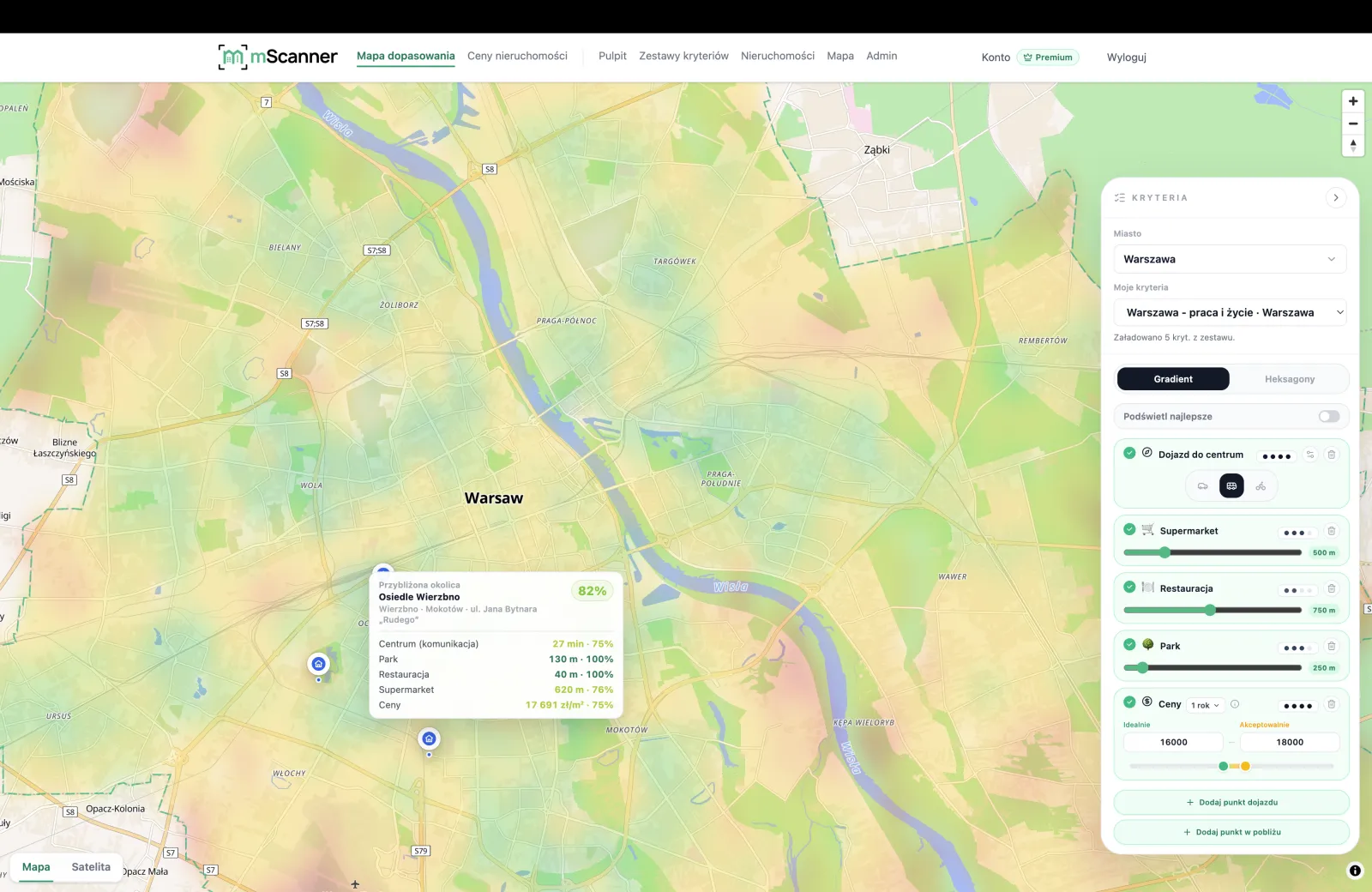
In mScanner you can pick location criteria and check which areas best fit your needs. It is then worth setting the result against the price and the report for a specific address.
Frequently asked questions
How does mScanner help choose where to live in Gdynia?
It helps compare specific addresses by commutes, services, greenery, noise, the zoning plan, prices and your own location criteria.
Does mScanner replace viewing a flat?
No. mScanner helps organise the most important questions before deciding, but viewings, documents and professional checks are still needed.
Is it worth comparing several flats at once?
Yes. Comparing several saved flats helps you see whether you are paying extra for a real location advantage or just for the wording of the listing.
Which districts in Gdynia are the greenest?
It depends on how close to a park, forest or water you want to live and which way you travel day to day. Instead of a generic ranking, the mScanner city heatmap scores areas by real access to greenery — set that criterion and see which addresses come out best for you.
Where in Gdynia are the cheaper districts?
The lowest price per m² is not always the best choice — a cheap address can be far from work or services. The price map shows the price distribution, and the city heatmap sets price against the commute and surroundings, so you do not save at the cost of your daily commute.
Where to live in Gdynia for a good commute to work or the centre?
Start with the question: by car or transit, and at what hours? The city heatmap computes the travel time from each area to the points you choose — work, school or the centre — so instead of guessing you see which districts give a fast commute on your routes.
How do I find a quiet, calm district in Gdynia?
Quiet depends on more than the absence of a busy street — proximity to large developments and the building plan matter too. The city heatmap factors in a noise criterion, and the address report shows the zoning plan and surroundings, so you can check whether the calm is lasting.
Which district in Gdynia is best for a family, a single person or a student?
There is no single best district — a family values schools, quiet and greenery, a single person values proximity to the centre and transport, and a student values rent and the commute to campus. In the city heatmap you set the weights of these criteria and get a result tailored to your profile.