Districts and neighbourhoods in Wroclaw
Wrocław is divided into five historic administrative districts (Stare Miasto, Śródmieście, Krzyki, Fabryczna, Psie Pole) and nearly 50 estates. The character of each area changes markedly: from the dense historic core of tenements, through leafy pre-war garden estates and large-panel prefab blocks, to new developer-built schemes on the outskirts.
Stare Miasto
The historic heart of the city: the Market Square, Ostrów Tumski cathedral island and hundreds of tenements housing restaurants, cafés and cultural venues. The built fabric is dense city-centre frontage; towards Kępa Mieszczańska and Szczepin newer developer projects are appearing. Everything is within walking distance and served by a dense tram network, but it is noisy, busy and pricier.
Suitsthose who want city-centre life without needing a car
Śródmieście
A ring of dense 19th- and 20th-century tenements encircling the Old Town, interspersed with squares and small parks. It includes Nadodrze (being regenerated, with studios and cafés), Ołbin, and the area around Plac Grunwaldzki with its university campuses. Close to the centre and universities with good transport links, though some tenements still await renovation and parking is scarce.
Suitsstudents, renters and anyone wanting to live near the city centre
BiskupinŚródmieście
Part of the so-called Wielka Wyspa (Great Island), surrounded by channels and branches of the Oder. Pre-war villas, semi-detached houses and low-rise buildings with gardens predominate, next to Szczytnicki Park, the Centennial Hall, Wrocław Zoo and the Olympic Stadium and AWF sports grounds. Quiet and green, with good tram links to the centre, though prices rank among the highest in the city.
Suitsfamilies and those who value tranquillity, greenery and a prestigious address
SępolnoŚródmieście
A pre-war garden estate built between 1919 and 1935, designed as a garden city for the middle classes; its street layout resembles an eagle from the air. Low-rise terraced and detached housing with generous greenery and a central square, right next to Szczytnicki Park and the Oder. Intimate and green, though the supply of flats is limited and you need to travel to reach the centre.
Suitsfamilies looking for peace and greenery close to the park
Karłowice-RóżankaŚródmieście
Karłowice is a pre-war estate of preserved German villas and tenements; adjacent Różanka is greener, with blocks of flats and newer developments. The main draw is Kasprowicza Park along the Oder and a dense tram network into the centre. Calm and leafy in the north of the city, though Różanka has a more mixed, blocky feel compared with the villa character of Karłowice.
Suitsthose who appreciate greenery and a pre-war atmosphere with good transport links
Krzyki (Powstańców Śląskich)Krzyki
The area around Powstańców Śląskich Street, one of the main southern arterials, where large-panel prefab blocks dominate the roadside and the tram and bus network is very frequent. Close to the centre, office districts and Południowy Park, with a full range of local services. Excellent transport links, though it is busy and there is little land available for new development.
Suitspeople who want to live near the centre with strong public transport
BorekKrzyki
A quiet, villa-lined part of Krzyki with pre-war houses and tenements set amid extensive greenery. Nearby are the large Południowy Park and Skowroni Park, and the centre is within easy reach. Sought-after and peaceful, but one of the pricier areas of the city with limited housing supply.
Suitsfamilies who value prestige, greenery and low-rise surroundings
HubyKrzyki
A densely built estate between the centre and the south, combining tenements, post-war blocks and newer infill developer schemes. Close to the main railway station with good access to trams and trains. Excellent connectivity and proximity to the centre, but it is a compact, urban environment with few large green spaces.
Suitspeople who want to live near the station and city centre
GajKrzyki
A southern estate with varied housing stock: large-panel prefab blocks sit alongside detached houses and more recent developments. Tram services to the centre run along Borowska and Świeradowska streets. A well-established, residential location with full local infrastructure, though without any distinctive architectural character.
Suitsfamilies looking for a proven, well-connected neighbourhood
TarnogajKrzyki
A south-eastern estate mixing prefab blocks, buildings echoing pre-war styles and a formerly industrial character with allotment gardens. New developer projects are arriving in increasing numbers. Quieter and cheaper than the centre, though parts of the area still await regeneration and improved transport.
Suitsthose looking for a cheaper flat in a quieter neighbourhood
JagodnoKrzyki
One of the fastest-growing estates, at the southern edge of the city, where thousands of new flats in dense, low-rise blocks have risen from former fields. Fresh developments and prices below those of the centre, but the estate struggles with congestion on Buforowa Street and the absence of a tram line (long planned but slow to materialise).
Suitsbuyers of new-build flats who are willing to accept a longer commute
OłtaszynKrzyki
A southern estate with a predominance of villas and detached houses, supplemented by apartment blocks built after 2000. The atmosphere is quiet and semi-suburban, with plenty of greenery. Peaceful and intimate, but further from the centre and served mainly by buses.
Suitsthose who value tranquillity and a house or flat away from the urban bustle
KlecinaKrzyki
A southern estate bordering Oporów, Partynice and the suburban village of Bielany, with highly varied housing: from pockets of rural character through terraced houses and villas to new apartment blocks and office buildings. Close to a retail park and the ring road. Convenient for drivers, but sprawling and without a coherent centre.
Suitscar owners who value easy access to the ring road and retail
Grabiszyn-GrabiszynekFabryczna
An estate divided by Hallera Avenue: the denser, older Grabiszyn with tenements and blocks, and the villa-lined Grabiszynek from the 1930s in a garden-city style. The showpiece is the extensive Grabiszyński Park with its cemeteries and green spaces. Leafy and close to the centre, though the character and atmosphere differ sharply between the two halves.
Suitsthose who value greenery and proximity to the centre without inner-city noise
PopowiceFabryczna
A large prefab-block estate from the 1970s on the Oder's west bank, to the west of the centre. Since 2023 it has been served by new tram lines crossing the river via Popowicka Street, with stops next to Popowicki Park and along the riverbank. Good tram links to the centre and riverside amenities, but it is a typical housing estate with repetitive architecture.
Suitsthose looking for a flat near the centre with good tram connections
SzczepinStare Miasto
An estate just west of the Old Town, within the inner city zone, mixing large-panel prefab blocks, tenements and numerous new developer schemes. Very close to the centre, with tram access and the Wrocław Szczepin railway halt nearby. A convenient location, but densely built with limited greenery.
Suitsthose who value proximity to the centre and want a new-build flat
Nowy DwórFabryczna
A western prefab-block estate, in recent years connected to the centre by a new tram-bus rapid transit route (TAT). The surrounding area has allotments and new residential schemes whose scale has sometimes been contested by residents. Improved transport links and lower prices, but a distinctly dormitory character.
Suitsthose looking for a cheaper flat served by a new tram route
Muchobór Wielki / MałyFabryczna
Former suburban villages on the western edge of the city. Muchobór Mały is characterised by semi-detached and terraced houses surrounded by allotment gardens, while Muchobór Wielki is being intensively built up with new developer estates on its outskirts. Close to the ring road and the office zone, but further from the centre and served mainly by buses.
Suitscar owners looking for a new flat or house
MaśliceFabryczna
A north-western estate on the Oder, with a predominance of detached houses and low-rise blocks, partly semi-suburban in feel. Wrocław Stadium and the A8 motorway ring road are nearby; a tram line is under construction and should improve access. Green and intimate, but public transport is still limited at present.
Suitsthose who value a house and green surroundings away from the city-centre bustle
LeśnicaFabryczna
The most westerly part of the city, with a preserved historic market square, a palace and a historical street pattern that gives it the feel of a small town. The housing stock includes tenements, council buildings and villas, with its own railway station and a tram line to the centre. Quiet and with its own identity, but on the periphery — the furthest point from the centre.
Suitsthose who appreciate a small-town atmosphere and access to the railway
Psie Pole
A large historic district in the north-east — a genuine mosaic: a historic market square with tenements, large-panel prefab blocks from the communist era (built partly for workers at nearby factories), former villages and large new developer schemes. Prices and character vary considerably by sub-area, but in general it is further from the city centre.
Suitsthose looking for varied housing options and lower prices in the north of the city
These descriptions are informational — the best district depends on your criteria. Score the district match on the map →
How to choose a location
The question is whether an address fits your day, not only where it's cheaper. mScanner helps analyse a location in Wroclaw through concrete criteria, not through a district's general reputation.
First it is worth deciding what matters most to you: the commute, quiet, greenery, schools, services, transport or quick access to the centre.
Local differences in Wroclaw
When choosing a flat, compare areas such as Stare Miasto, Śródmieście, Biskupin, Sępolno, Krzyki, Borek, Gaj, Tarnogaj, Jagodno and Ołtaszyn. Each of them can look different on the commute, services, greenery, noise and price.
Wrocław is worth comparing with Długołęka, Siechnice, Czernica, Kobierzyce, Kąty Wrocławskie and Oława. The outskirts can buy more space, but whether it makes sense depends on the rail, the road and the last leg to work.
Commutes
A commute is best measured to specific places, not just to the centre. For one person the best address is near a stop, for another near a good motorway access or a school.
An estate with a tram line or a railway station usually works differently from a similarly placed address that relies mostly on buses.
Greenery and recreation
Proximity to greenery affects daily life, but the distance to a park alone is not enough. It is worth checking the real access to walking, waterside and recreation areas.
Nearby services
Shops, nurseries, schools, clinics and everyday service points can save more time than a few minutes saved on the commute to the centre.
Noise and surroundings
Noise, busy streets, proximity to large developments and the character of the buildings are worth assessing before you decide on a flat — whether you are buying or renting.
The zoning plan (MPZP) and the area plan
The local zoning plan (MPZP) and the urban surroundings help you understand what might be built nearby and whether the current view from the window is a lasting feature of the location.
How to use the mScanner city heatmap
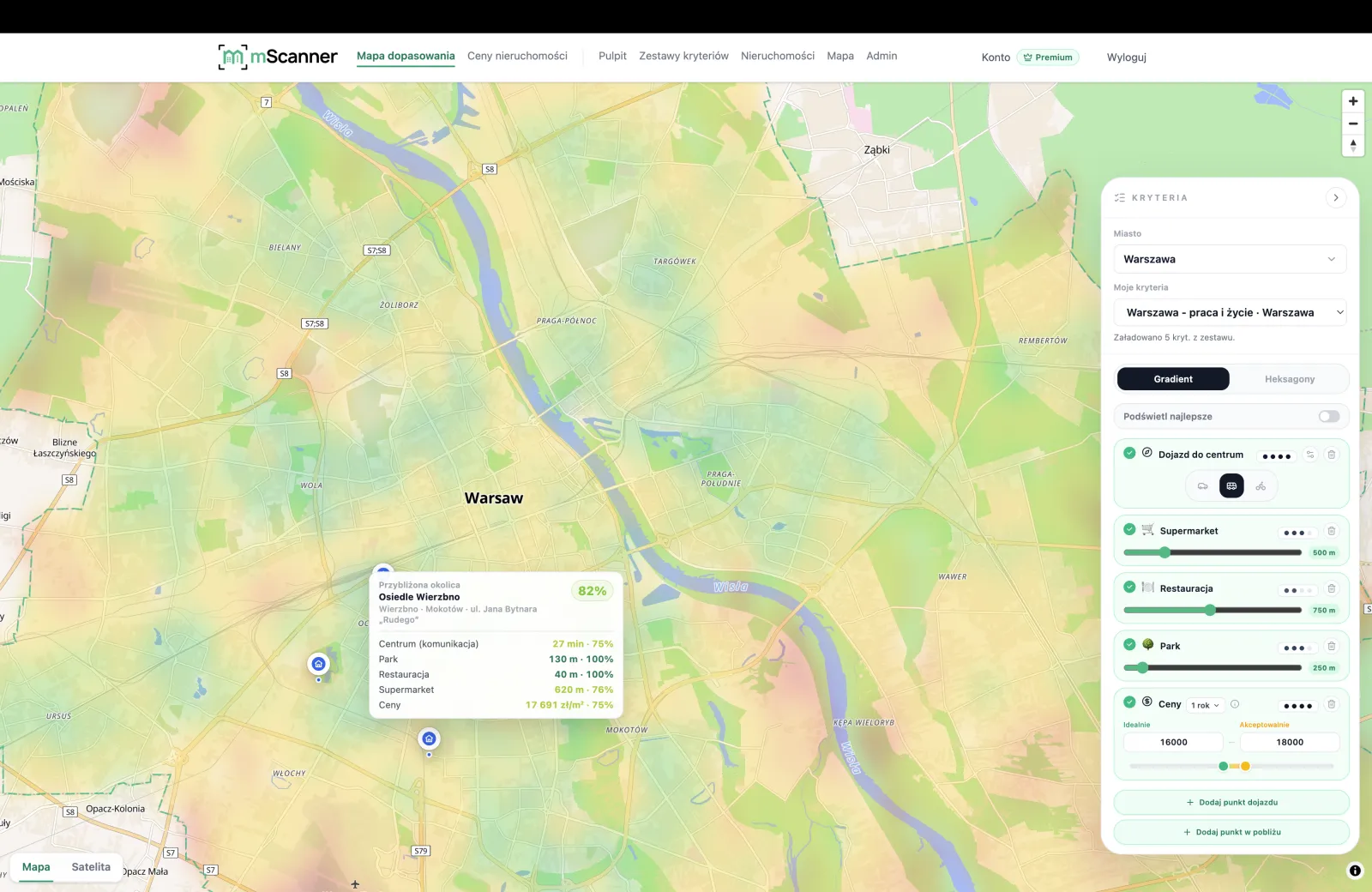
In mScanner you can pick location criteria and check which areas best fit your needs. It is then worth setting the result against the price and the report for a specific address.
Frequently asked questions
How does mScanner help choose where to live in Wroclaw?
It helps compare specific addresses by commutes, services, greenery, noise, the zoning plan, prices and your own location criteria.
Does mScanner replace viewing a flat?
No. mScanner helps organise the most important questions before deciding, but viewings, documents and professional checks are still needed.
Is it worth comparing several flats at once?
Yes. Comparing several saved flats helps you see whether you are paying extra for a real location advantage or just for the wording of the listing.
Which districts in Wroclaw are the greenest?
It depends on how close to a park, forest or water you want to live and which way you travel day to day. Instead of a generic ranking, the mScanner city heatmap scores areas by real access to greenery — set that criterion and see which addresses come out best for you.
Where in Wroclaw are the cheaper districts?
The lowest price per m² is not always the best choice — a cheap address can be far from work or services. The price map shows the price distribution, and the city heatmap sets price against the commute and surroundings, so you do not save at the cost of your daily commute.
Where to live in Wroclaw for a good commute to work or the centre?
Start with the question: by car or transit, and at what hours? The city heatmap computes the travel time from each area to the points you choose — work, school or the centre — so instead of guessing you see which districts give a fast commute on your routes.
How do I find a quiet, calm district in Wroclaw?
Quiet depends on more than the absence of a busy street — proximity to large developments and the building plan matter too. The city heatmap factors in a noise criterion, and the address report shows the zoning plan and surroundings, so you can check whether the calm is lasting.
Which district in Wroclaw is best for a family, a single person or a student?
There is no single best district — a family values schools, quiet and greenery, a single person values proximity to the centre and transport, and a student values rent and the commute to campus. In the city heatmap you set the weights of these criteria and get a result tailored to your profile.