Districts and neighbourhoods in Warsaw
Warsaw is divided by the Vistula into two distinct halves: the denser, more expensive west bank (Śródmieście, Wola, Mokotów) and the calmer, more affordable east bank (Praga, Białołęka, Wawer). When choosing a neighbourhood, the key factors are access to the metro (two lines), the character of the housing stock — ranging from tenements and large-panel prefab blocks to new-build developments — and distance from the centre.
Śródmieście
The city's tight core, with its densest mix of tenements, office buildings, the Old Town and skyscrapers around the Palace of Culture. Both metro lines cross here, as do most tram routes and the main railway termini, and virtually everything is within walking distance. The highest prices in the city, noisy, and parking is a constant struggle.
Suitspeople who value a central location and life without a car
Wola
A former industrial district that has undergone a thorough transformation — alongside old tenements and large-panel prefab blocks, apartment towers and a cluster of office skyscrapers have risen around Rondo Daszyńskiego. The M2 metro line runs through here, trams are frequent, and the centre is close. Dynamic and well connected, though in places it is still a building site and the new high-rise can feel overbearing.
Suitspeople who work in the centre and want a metro stop on their doorstep
Rondo DaszyńskiegoWola
The business heart of the new Wola — a cluster of office towers sometimes called Warsaw's Manhattan, served by the M2 metro station and numerous tram lines. New apartment buildings with ground-floor retail are rising all around. Excellent transport links and close to the centre, but the character is emphatically metropolitan and prices are high.
Suitscorporate workers and short-term renters
OdolanyWola
The western part of Wola, formerly railway and industrial land, now one of the most intensively built-up areas in the city, with new developer estates going up year after year. Close to Rondo Daszyńskiego and the centre, but construction is still ongoing and mature infrastructure and green space are in short supply.
Suitspeople looking for a new-build flat near the centre at a reasonable price
Mokotów
A large, varied district with highly diverse housing: pre-war tenements, embassy villas, large-panel prefab estates and new apartment buildings all sit side by side. The M1 metro line runs through it (including Pole Mokotowskie, Wierzbno and Wilanowska stations), and Pole Mokotowskie park and other green areas are on hand. A prestigious address, though prices and character vary considerably depending on the specific part of the district.
Suitspeople who value varied housing stock and good metro access
SłużewiecMokotów
The south-western part of Mokotów is dominated by offices — more than 80 office buildings, colloquially known as Mordor, employing tens of thousands of people. New apartment buildings are appearing alongside them, and transport is provided by the metro (Służew, Wilanowska) and trams. Excellent for getting to work, but it empties out at weekends and lacks an urban street life.
Suitspeople who work in the office district and want a short commute
Żoliborz
A small, green district conceived as a garden district, with Modernist and villa-style buildings along quiet, tree-lined streets. It has M1 metro stations (Plac Wilsona, Marymont) and is close to the centre. Intimate and family-friendly in character, but supply of homes is limited and prices are high.
Suitsfamilies who value peace and greenery close to the centre
Bielany
A large northern district with abundant green space, including the Bielański Forest nature reserve. The housing stock is mixed: large-panel prefab blocks, older estates and new developments. The M1 metro line extends all the way to Młociny, where there is a major transport interchange. Quiet and green, though further from the city centre.
Suitspeople who want greenery and metro access in a quieter setting
Ochota
A small, densely built district of pre-war and post-war tenements, bordering Pole Mokotowskie park and the Filtry waterworks area. Several universities cluster nearby — Warsaw University of Technology, the University of Warsaw and the Medical University of Warsaw. Close to the centre with good tram connections, but compact and without its own metro station deeper into the district.
Suitsstudents, university staff, and landlords letting to them
Saska KępaPraga-Południe
An east-bank neighbourhood with 1920s and 1930s villa housing, low tenements along ulica Francuska and newer apartment buildings. It borders Skaryszewski Park and the bank of the Vistula, and has a well-kept, intimate feel. Close to the centre via the bridges, though prices are among the highest on the right bank.
Suitspeople who want a characterful, green and low-key neighbourhood
GocławPraga-Południe
An estate of 1970s and 1980s prefab blocks built on a former airfield, with Jeziorko Gocławskie lake and green space along the Exhibition Canal. The large-panel blocks sit in spacious grounds with views of the Vistula from the riverside edge. Quiet and family-orientated, but there is no metro — buses and trams are the only options.
Suitsfamilies looking for spacious, lower-priced estates
Praga-Północ
A historic right-bank district that has preserved its pre-war fabric: listed tenements, cobbled streets and courtyard interiors. The Warsaw Zoo, Bazar Różyckiego and the revitalised Centrum Praskie Koneser complex in a former vodka distillery are all here, and the M2 metro (Dworzec Wileński, Szwedzka) has improved connections. Full of character and close to the centre, though some tenements still await renovation and quality varies.
Suitspeople drawn to atmosphere, culture and proximity to the centre
Ursynów
Warsaw's largest residential complex, mostly large-panel prefab (Natolin, Stokłosy), with the southern Kabaty neighbourhood next to the Kabacki Forest. The M1 metro line starts here at Kabaty, giving a comfortable ride into the centre. Quiet, green and family-friendly, but further south in the city and with a dormitory feel in places.
Suitsfamilies who value the metro, green space and a quieter residential setting
Wilanów
A district synonymous with the historic Wilanów Palace, next to which the new Miasteczko Wilanów has grown up — a large apartment estate dominated by the Temple of Divine Providence. The housing is new and coherent, with shops and schools in place, and a tram line along Aleja Rzeczypospolitej has improved connections. Smart and low-key in character, but without a metro and further from the centre.
Suitsfamilies who value new, well-ordered development
Białołęka
The fastest-growing district, on the northern edge of the city, where thousands of new developer flats are built every year. The absence of a metro and weaker connections to the centre (buses and car) are the main reasons for lower prices. Plenty of new estates and space, but infrastructure is struggling to keep pace with construction and commutes can be long.
Suitspeople looking for a new-build flat at a lower price
Bemowo
A western district with mixed housing — large-panel prefab estates, 1990s blocks and a growing volume of new developments. The extension of the M2 metro line (stations: Bemowo, Chrzanów, Lazurowa, Karolin) has significantly improved connections. Quiet and served by the metro, but further from the city centre, with the airport in the vicinity.
Suitspeople who want new development with metro access
Wawer
The largest district by area and the greenest, characterised by low-rise single-family housing, including wooden villas in the świdermajer style. Part of the Mazovian Landscape Park with nature reserves and small lakes lies within its boundaries. The railway line to Otwock, with numerous stations (Anin, Międzylesie, Radość, Falenica), provides the main transport link. Quiet, intimate and close to nature, but far from the centre and distinctly suburban in feel.
Suitspeople who value peace, greenery and a house with a garden
These descriptions are informational — the best district depends on your criteria. Score the district match on the map →
How to choose a location
The question is whether an address fits your day, not only where it's cheaper. mScanner helps analyse a location in Warsaw through concrete criteria, not through a district's general reputation.
First it is worth deciding what matters most to you: the commute, quiet, greenery, schools, services, transport or quick access to the centre.
Local differences in Warsaw
When choosing a flat, compare areas such as Śródmieście, Wola, Rondo Daszyńskiego, Odolany, Mokotów, Służewiec, Żoliborz, Bielany, Ochota and Saska Kępa. Each of them can look different on the commute, services, greenery, noise and price.
It is worth comparing Warsaw with the towns around it — Piaseczno, Pruszków, Legionowo, Ząbki, Marki, Otwock or Grodzisk Mazowiecki. The outskirts can buy more space, but you have to count the commute and how dependent you become on a car.
Commutes
A commute is best measured to specific places, not just to the centre. For one person the best address is near a stop, for another near a good motorway access or a school.
Two addresses in the same district can mean a completely different commute if one is close to the metro or the railway and the other needs a transfer or two.
Greenery and recreation
Proximity to greenery affects daily life, but the distance to a park alone is not enough. It is worth checking the real access to walking, waterside and recreation areas.
Nearby services
Shops, nurseries, schools, clinics and everyday service points can save more time than a few minutes saved on the commute to the centre.
Noise and surroundings
Noise, busy streets, proximity to large developments and the character of the buildings are worth assessing before you decide on a flat — whether you are buying or renting.
The zoning plan (MPZP) and the area plan
The local zoning plan (MPZP) and the urban surroundings help you understand what might be built nearby and whether the current view from the window is a lasting feature of the location.
How to use the mScanner city heatmap
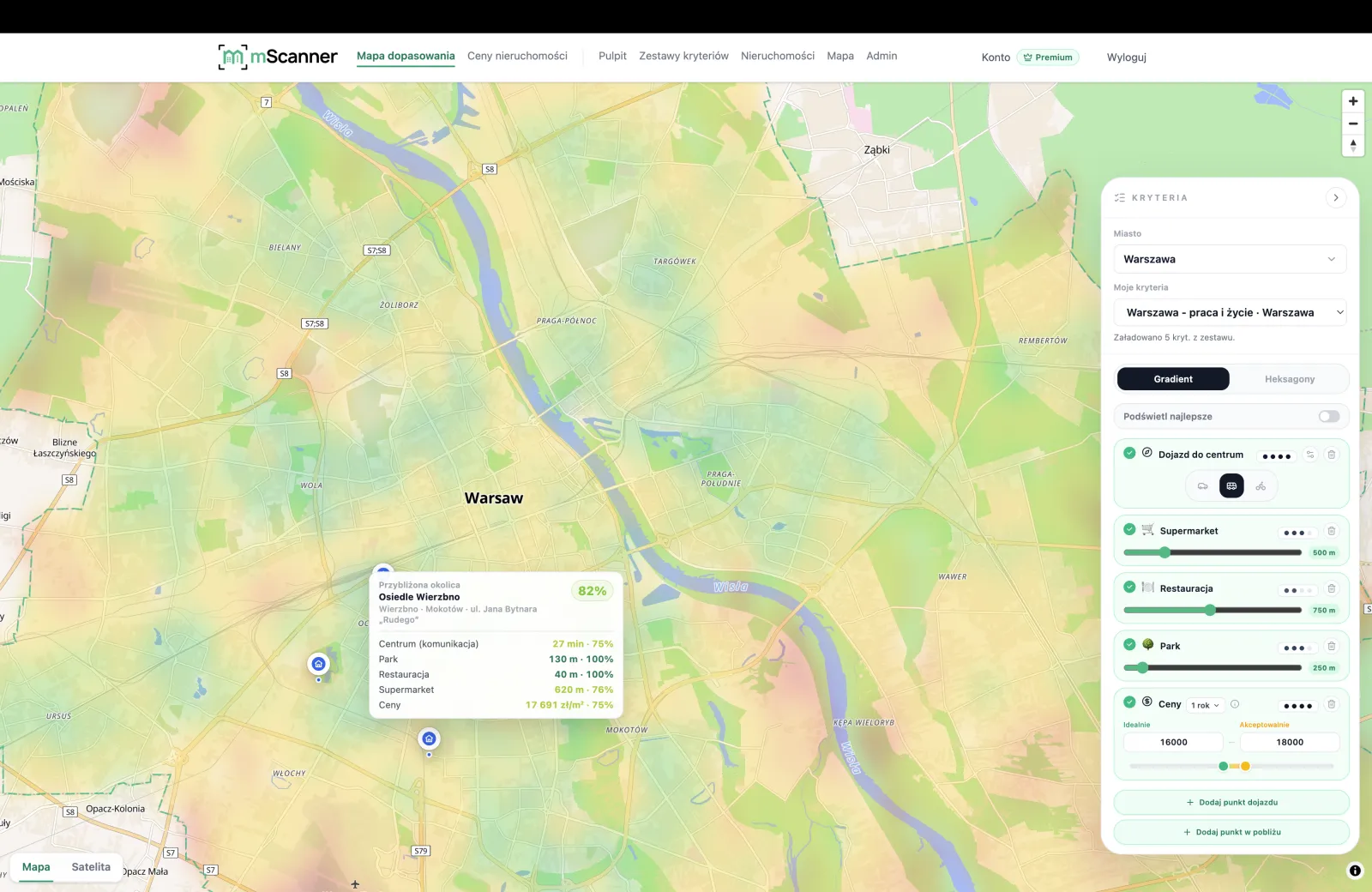
In mScanner you can pick location criteria and check which areas best fit your needs. It is then worth setting the result against the price and the report for a specific address.
Frequently asked questions
How does mScanner help choose where to live in Warsaw?
It helps compare specific addresses by commutes, services, greenery, noise, the zoning plan, prices and your own location criteria.
Does mScanner replace viewing a flat?
No. mScanner helps organise the most important questions before deciding, but viewings, documents and professional checks are still needed.
Is it worth comparing several flats at once?
Yes. Comparing several saved flats helps you see whether you are paying extra for a real location advantage or just for the wording of the listing.
Which districts in Warsaw are the greenest?
It depends on how close to a park, forest or water you want to live and which way you travel day to day. Instead of a generic ranking, the mScanner city heatmap scores areas by real access to greenery — set that criterion and see which addresses come out best for you.
Where in Warsaw are the cheaper districts?
The lowest price per m² is not always the best choice — a cheap address can be far from work or services. The price map shows the price distribution, and the city heatmap sets price against the commute and surroundings, so you do not save at the cost of your daily commute.
Where to live in Warsaw for a good commute to work or the centre?
Start with the question: by car or transit, and at what hours? The city heatmap computes the travel time from each area to the points you choose — work, school or the centre — so instead of guessing you see which districts give a fast commute on your routes.
How do I find a quiet, calm district in Warsaw?
Quiet depends on more than the absence of a busy street — proximity to large developments and the building plan matter too. The city heatmap factors in a noise criterion, and the address report shows the zoning plan and surroundings, so you can check whether the calm is lasting.
Which district in Warsaw is best for a family, a single person or a student?
There is no single best district — a family values schools, quiet and greenery, a single person values proximity to the centre and transport, and a student values rent and the commute to campus. In the city heatmap you set the weights of these criteria and get a result tailored to your profile.