Districts and neighbourhoods in Szczecin
Szczecin is divided administratively into four districts: Śródmieście, Północ, Zachód, and Prawobrzeże, each comprising dozens of estates. The centre and its surroundings are characterised by tenements and post-war development; the west and north combine villas, blocks, and detached houses; while the right bank (beyond the Oder) features large-panel prefab blocks and newer developments near the Bukowa Forest and Lake Dąbie.
Śródmieście
The city's dense historic core, built around a star-shaped layout of streets and squares, with pre-war tenements throughout. It is home to the Castle of the Pomeranian Dukes, the Wały Chrobrego promenade, major shopping centres, public offices, and the main transport hubs. Excellent access to services and trams, though it is noisy, parking is tight, and prices are higher than on the outskirts.
Suitsthose who value city-centre living and full access to amenities without a car
NiebuszewoŚródmieście
A former working-class and industrial quarter (home to the Stoewer works) with a mix of tenements and modernist blocks from the 1920s and 1930s, including a planned cooperative estate between ul. Krasińskiego, Niemcewicza, and Kołłątaja. Close to the centre and al. Wyzwolenia, though part of the building stock is in need of refurbishment.
Suitsthose looking for a flat near the centre in pre-war housing at a lower price
TurzynŚródmieście
The western part of the city centre, with pre-war tenements complemented by post-war infill where wartime damage occurred. Al. Bohaterów Warszawy runs through the estate, and plac Kościuszki lies at its edge; renovation of entire blocks is ongoing. Well connected and close to the centre, though main arteries can be busy.
Suitsthose who value proximity to the centre and good tram connections
PogodnoZachód
A villa estate dating from the early twentieth century, supplemented by pre-war and more recent apartment blocks near Magnolia Park and Somosierra. The main artery is ul. Mickiewicza; the estate borders Park Kasprowicza, hosts the Miejski Stadium (Pogoń Szczecin), and is home to facilities of the Pomeranian Medical University. Trams 5 and 7 provide connections. Quiet and leafy, though prices are higher than in the block estates.
Suitsfamilies and those seeking a villa-style, green neighbourhood close to the centre
PomorzanyZachód
An estate split by a railway line, with housing stock predominantly from the 1970s and 1980s alongside several industrial facilities. Szczecin Pomorzany railway station and a tram terminus are located here, served by numerous tram routes. Good transport links and lower prices than the centre, though parts of the area have an industrial character.
Suitsthose looking for a well-connected flat in a block at a moderate price
GumieńceZachód
The second most populous estate, with a predominance of detached houses and the Reda block sub-estate. Szczecin Gumieńce station provides rail connections towards Berlin, and several faculties of the University of Szczecin (humanities and management) are located here. Quiet and close to the western border, though getting to the city centre requires a commute.
Suitsfamilies looking for a house or flat in a quiet, western part of the city
ŚwierczewoZachód
A block estate developed mainly in the 1970s and 1980s, subdivided into smaller units (including Przyjaźni and Kaliny). The built environment is predominantly residential with a scattering of businesses and utility buildings. A calm, dormitory neighbourhood with moderate prices and access to trams and buses.
Suitsthose looking for an affordable flat in a quiet, dormitory-style development
Krzekowo-BezrzeczeZachód
A predominantly residential estate with inter-war and post-war housing alongside allotment gardens (Krzekowo, Pionier). Several tram routes (including 4, 5, and 7) and bus services connect it to the centre. Quiet and green, situated on the western edge of the city, further from the centre.
Suitsthose who value peace and greenery with a tram ride into the centre
WarszewoPółnoc
One of the fastest-growing estates, set on elevated ground to the north of the centre, with new developer-built projects, detached houses, and blocks from the 2000s. Close to green spaces and the Wkrzańska Forest. New housing stock and pleasant views, though public transport connections are weaker than in the centre.
Suitsfamilies looking for a new home with access to green space
OsówPółnoc
A detached-house estate perched on a ridge above 110 metres above sea level, with low-rise villa development built mainly from the 1980s onwards and newer projects (including along ul. Andersena and Miodowa). Peaceful and green, but far from the centre and reliant on a car.
Suitsthose who value quiet and their own home away from the bustle of the centre
BukowoPółnoc
An estate on the northern edge of the city, with a predominance of detached houses and low-rise development, affordably priced and peaceful. Close to green spaces, but peripheral, with a longer commute to the centre and limited public transport.
Suitsthose looking for an affordable house on the quiet outskirts of the city
ZdrojePrawobrzeże
An estate on the right bank of the Oder, close to the bridges leading to the city centre, with a mix of pre-war development and large-panel prefab blocks. Nearby are Lake Szmaragdowe, Wzgórze Szmaragdowe, and the Bukowa Forest; the large Zdroje Hospital is located here. Good access to nature and the centre, though much of the housing stock is older prefab.
Suitsthose who value proximity to forests and lakes with a quick commute to the centre
SłonecznePrawobrzeże
A densely populated estate from the 1970s, built using the Szczecin system, with distinctive twelve-storey towers arranged in star formations and colourful post-refurbishment façades. A typical large-panel prefab estate with well-developed retail and service provision. Affordable and convenient for everyday needs, though compact and without a villa character.
Suitsthose looking for an affordable flat with a full range of local amenities
Bukowe-KlęskowoPrawobrzeże
The most populous estate in Szczecin, developed on the land of the former village of Klęskowo, with block housing and good retail provision. It borders the Bukowa Forest and is popular with families with children. Calm and close to the forest, though far from the city centre and without a tram.
Suitsfamilies who value proximity to the forest and good estate infrastructure
PodjuchyPrawobrzeże
An estate developed on the site of a former village, whose south-eastern portion is bounded by the Bukowa Forest and the Szczecin Landscape Park. The Szczecin Metropolitan Railway (Szczecin Podjuchy station) stops here, with a Park & Ride facility. Quiet and green, with a fast rail link to the centre, though it has a peripheral, suburban character.
Suitsthose who value greenery and a metropolitan railway commute to the centre
DąbiePrawobrzeże
A former small town on the shore of Lake Dąbie (approximately 56 km²), with a fragment of medieval town walls and an aero club airfield. It combines near-suburban housing with a tram connection (terminus on ul. Turkusowa) and water sports on the lake. Peaceful and close to the water, though a long way from the city centre.
Suitsthose who value lakeside living and water sports away from the noise of the centre
These descriptions are informational — the best district depends on your criteria. Score the district match on the map →
How to choose a location
The question is whether an address fits your day, not only where it's cheaper. mScanner helps analyse a location in Szczecin through concrete criteria, not through a district's general reputation.
First it is worth deciding what matters most to you: the commute, quiet, greenery, schools, services, transport or quick access to the centre.
Local differences in Szczecin
When choosing a flat, compare areas such as Śródmieście, Niebuszewo, Pogodno, Pomorzany, Gumieńce, Turzyn, Świerczewo, Krzekowo, Warszewo and Osów. Each of them can look different on the commute, services, greenery, noise and price.
Szczecin is worth comparing with Police, Goleniów, Stargard and Gryfino, and — given the nearby border — with commutes towards Germany. The outskirts can be cheaper, but you have to count the rail, the road and the daily travel time.
Commutes
A commute is best measured to specific places, not just to the centre. For one person the best address is near a stop, for another near a good motorway access or a school.
An address on the right bank and one in the centre often mean a completely different commute, because so much depends on the bridges and the tram axis. Some people also travel towards Police, Goleniów or across the border.
Greenery and recreation
Proximity to greenery affects daily life, but the distance to a park alone is not enough. It is worth checking the real access to walking, waterside and recreation areas.
Nearby services
Shops, nurseries, schools, clinics and everyday service points can save more time than a few minutes saved on the commute to the centre.
Noise and surroundings
Noise, busy streets, proximity to large developments and the character of the buildings are worth assessing before you decide on a flat — whether you are buying or renting.
The zoning plan (MPZP) and the area plan
The local zoning plan (MPZP) and the urban surroundings help you understand what might be built nearby and whether the current view from the window is a lasting feature of the location.
How to use the mScanner city heatmap
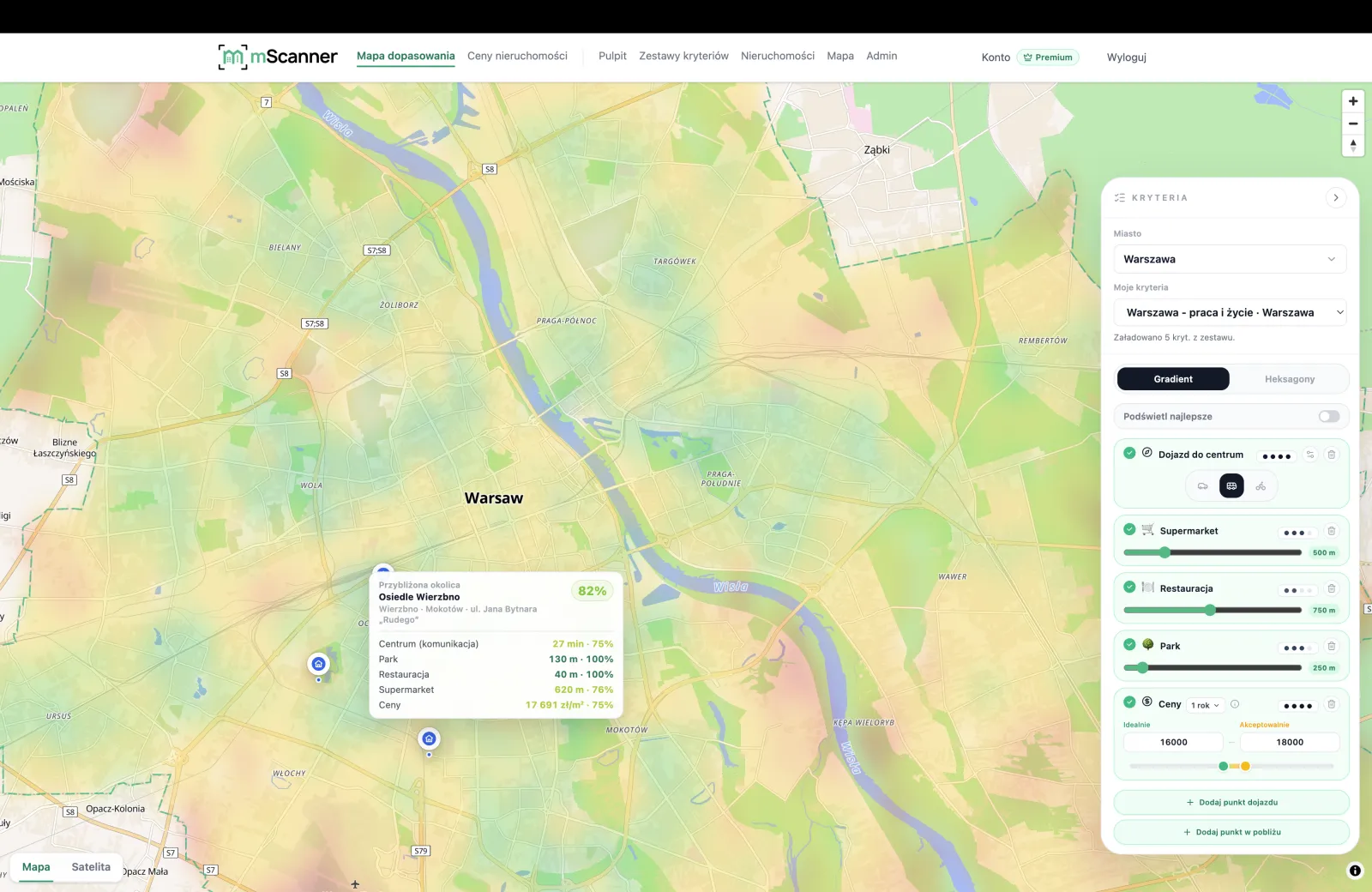
In mScanner you can pick location criteria and check which areas best fit your needs. It is then worth setting the result against the price and the report for a specific address.
Frequently asked questions
How does mScanner help choose where to live in Szczecin?
It helps compare specific addresses by commutes, services, greenery, noise, the zoning plan, prices and your own location criteria.
Does mScanner replace viewing a flat?
No. mScanner helps organise the most important questions before deciding, but viewings, documents and professional checks are still needed.
Is it worth comparing several flats at once?
Yes. Comparing several saved flats helps you see whether you are paying extra for a real location advantage or just for the wording of the listing.
Which districts in Szczecin are the greenest?
It depends on how close to a park, forest or water you want to live and which way you travel day to day. Instead of a generic ranking, the mScanner city heatmap scores areas by real access to greenery — set that criterion and see which addresses come out best for you.
Where in Szczecin are the cheaper districts?
The lowest price per m² is not always the best choice — a cheap address can be far from work or services. The price map shows the price distribution, and the city heatmap sets price against the commute and surroundings, so you do not save at the cost of your daily commute.
Where to live in Szczecin for a good commute to work or the centre?
Start with the question: by car or transit, and at what hours? The city heatmap computes the travel time from each area to the points you choose — work, school or the centre — so instead of guessing you see which districts give a fast commute on your routes.
How do I find a quiet, calm district in Szczecin?
Quiet depends on more than the absence of a busy street — proximity to large developments and the building plan matter too. The city heatmap factors in a noise criterion, and the address report shows the zoning plan and surroundings, so you can check whether the calm is lasting.
Which district in Szczecin is best for a family, a single person or a student?
There is no single best district — a family values schools, quiet and greenery, a single person values proximity to the centre and transport, and a student values rent and the commute to campus. In the city heatmap you set the weights of these criteria and get a result tailored to your profile.