Districts and neighbourhoods in Rzeszow
Rzeszów spreads across both banks of the Wisłok: the tight city centre and large-panel prefab estates sit closest to the river, with a ring of former villages incorporated into the city radiating outward, dominated by detached housing and new developer estates. When choosing a neighbourhood, the key question is centre versus suburb — the centre is livelier, pricier, and within reach of everything, while the eastern and western outskirts are quieter and greener but further out and less well served by public transport.
Śródmieście
The city's tight historic core, home to the Market Square, town hall, the Underground Tourist Route, and rows of tenements shaped mainly in the late nineteenth and early twentieth centuries. Dense buildings, offices, restaurants and pedestrianised streets keep the area busy throughout the day. The district covers only around 1.7 km² yet has one of the highest population densities in the city.
Suitsthose who want to live without a car and have everything within walking distance
Nowe Miasto
One of Rzeszów's largest residential estates, built primarily between 1975 and 1990 with tall eleven-storey large-panel prefab blocks. The area is well equipped with schools, shops and recreational space, and the University of Rzeszów campus on Aleja Rejtana is nearby. Close to the centre, though the overall feel is that of a typical communist-era prefab estate.
Suitsthose seeking affordable flats close to the centre and university
Baranówka
A large estate to the north-west of the centre, built from the 1970s onwards on former farmland as a large-panel prefab development. Today it is fully urbanised: tall blocks sit alongside newer, lower-rise buildings, and retail and service infrastructure is well established. Primarily a residential, dormitory area with good bus links to the centre.
Suitsfamilies looking for ready-made infrastructure and regular bus services
Staromieście
One of the oldest parts of the city, lying to the north of the centre — formerly an independent village, now a sprawling estate of around 5.7 km² at a lower density than Śródmieście. A mix of older detached houses, tenements and pockets of multi-family blocks, retaining a semi-suburban feel. Close to the centre yet quieter and lower-rise.
Suitsthose who want to be near the centre but in lower-rise, quieter surroundings
Mieszka I
A quiet estate in the eastern part of the city, combining detached housing with low-rise flats. Predominantly residential in character, set away from the main thoroughfares and close to the Wisłok floodplain and surrounding estates. Calmer than the large prefab districts, though local services are not densely concentrated.
Suitsfamilies who value quiet, low-rise surroundings
Drabinianka
A large estate in the south of the city (around 5.7 km²) and one of Rzeszów's fastest-growing areas. Remnants of the original village fabric sit alongside numerous new developments: developer blocks, terraced houses and detached homes. Construction is ongoing and commutes are longer, but there is plenty of new housing and open space.
Suitsthose buying a new flat or house away from the bustle of the centre
Pobitno
An estate on the right (eastern) bank of the Wisłok, along Ulica Lwowska, with a mixed character and generous green space. The northern part retains wooden houses from its village past; the south is dominated by small blocks and detached homes. Close to the Wisłok riverside promenade and calmer than the western bank.
Suitsthose who value proximity to the river and green space in a varied neighbourhood
Słocina
The easternmost estate, a former village on the edge of the Rzeszów Foothills, with varied terrain and the characteristic loose ribbon development typical of the region. Detached homes and new developer builds dominate, with the Władysław Szafer Park and the Młynówka stream providing a green corridor. Green and low-key, but a long way from the centre.
Suitsthose looking for a house or new flat in a leafy, villa-style setting
Załęże
One of the older estates, east of the Wisłok, with a mixed profile: residential buildings sit alongside industrial land, a heating plant and warehouses (particularly around Ulica Ciepłownicza and Załęska). The character is more workaday than prestigious, and the area is close to arterial roads out of the city. Functional, but without a pastoral atmosphere.
Suitsthose working nearby who want a cheap, well-connected location
Zwięczyca
A former village in the south of the city, on the left bank of the Wisłok, close to a reservoir and the Lisia Góra nature reserve. Detached houses predominate with a small number of low-rise blocks, and the area is well connected by road towards Boguchwała. Quiet and close to water-based recreation, though further from the city centre.
Suitsthose who value peace, greenery and easy access to leisure along the Wisłok
Przybyszówka
A very large estate (over 17 km²) on the western edge of the city, formerly a village and now dominated by detached houses with gardens and abundant greenery. A small cluster of blocks (the Franciszek Kotula estate) occupies the southern part. The atmosphere is family-friendly and semi-rural, though the journey to the centre is longer.
Suitsfamilies looking for a house with a garden on the city's outskirts
Wilkowyja
An estate in the eastern part of the city, strung along the arterial Ulica Lwowska towards Przemyśl, incorporated into Rzeszów in 1977. A former suburban village, now mostly low-rise detached housing with some small blocks. Quiet and understated, with easy access to the eastern road out of the city, though further from the centre.
Suitsthose who want a quiet, low-rise setting with convenient access to the east
Biała
A southern estate, a former village on the River Strug (once known as Biała), incorporated into the city in stages in 1977 and 2009. Formerly agricultural, it is now gaining new estates of detached homes, semi-detached and terraced houses. The landscape remains partly rural with plenty of open space, though urban infrastructure is limited.
Suitsthose building or buying a house on the quiet outskirts of the city
Budziwój
The eastern part of the city and one of its largest estates by area (around 17.5 km²), incorporated into Rzeszów in 2010. The landscape is semi-rural, stretching along the Strug valley, with detached homes and large plots predominating. Peaceful, green and spacious, at the cost of a significant distance from the centre.
Suitsthose looking for a large plot and tranquillity away from the urban hustle
Krakowska-Południe
A small, densely built estate on the south side of Ulica Krakowska, developed on the site of a former military training ground as one of the newest estates of the Rzeszów Housing Cooperative. It combines older multi-family blocks with newer developments, and lies close to the Plaza shopping centre and arterial roads heading west. Convenient for residents and commuters, but compact and built-up.
Suitsthose looking for a flat with good transport links and shops close to hand
Tysiąclecia
An estate with history stretching back to the 1960s, built up with cooperative blocks — including distinctive point-block towers on Ulica Marszałkowska — and situated close to the centre. A typical older estate with mature trees and well-established local services. Walking distance from the city centre, though the architecture is firmly rooted in the communist era.
Suitsthose seeking a flat close to the centre in a settled, leafy neighbourhood
These descriptions are informational — the best district depends on your criteria. Score the district match on the map →
How to choose a location
The question is whether an address fits your day, not only where it's cheaper. mScanner helps analyse a location in Rzeszow through concrete criteria, not through a district's general reputation.
First it is worth deciding what matters most to you: the commute, quiet, greenery, schools, services, transport or quick access to the centre.
Local differences in Rzeszow
When choosing a flat, compare areas such as Śródmieście, Nowe Miasto, Staromieście, Baranówka, Mieszka I, Drabinianka, Pobitno, Słocina, Załęże and Zwięczyca. Each of them can look different on the commute, services, greenery, noise and price.
Rzeszów is worth comparing with Łańcut, Tyczyn, Boguchwała, Głogów Małopolski and Trzebownisko near the airport. The outskirts can be cheaper, but the car or bus commute and the everyday services count.
Commutes
A commute is best measured to specific places, not just to the centre. For one person the best address is near a stop, for another near a good motorway access or a school.
In Rzeszów the daily commute relies on buses and the car, and the A4 and S19 change the reach of everyday errands. Some people also travel towards the airport in Jasionka.
Greenery and recreation
Proximity to greenery affects daily life, but the distance to a park alone is not enough. It is worth checking the real access to walking, waterside and recreation areas.
Nearby services
Shops, nurseries, schools, clinics and everyday service points can save more time than a few minutes saved on the commute to the centre.
Noise and surroundings
Noise, busy streets, proximity to large developments and the character of the buildings are worth assessing before you decide on a flat — whether you are buying or renting.
The zoning plan (MPZP) and the area plan
The local zoning plan (MPZP) and the urban surroundings help you understand what might be built nearby and whether the current view from the window is a lasting feature of the location.
How to use the mScanner city heatmap
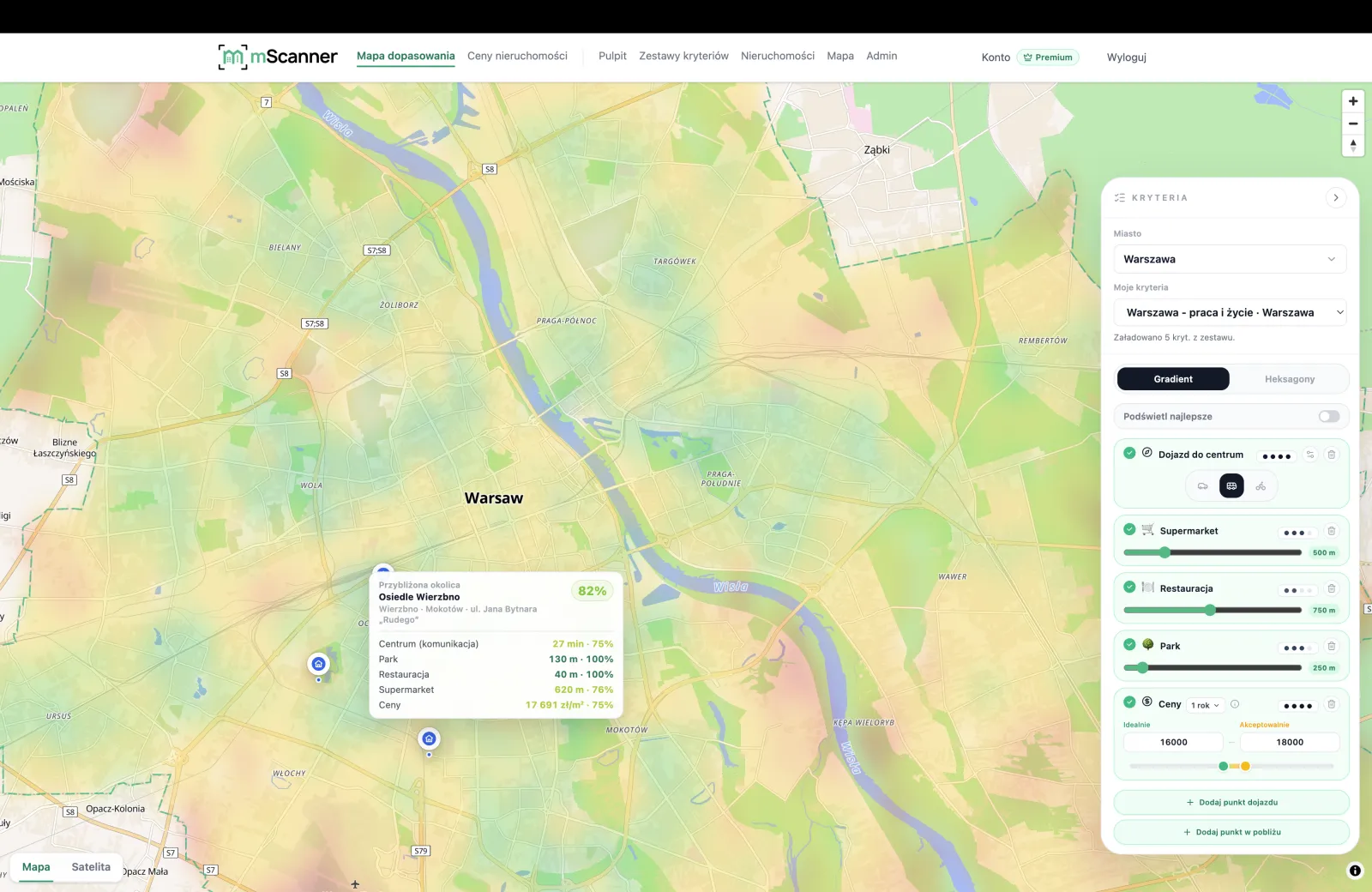
In mScanner you can pick location criteria and check which areas best fit your needs. It is then worth setting the result against the price and the report for a specific address.
Frequently asked questions
How does mScanner help choose where to live in Rzeszow?
It helps compare specific addresses by commutes, services, greenery, noise, the zoning plan, prices and your own location criteria.
Does mScanner replace viewing a flat?
No. mScanner helps organise the most important questions before deciding, but viewings, documents and professional checks are still needed.
Is it worth comparing several flats at once?
Yes. Comparing several saved flats helps you see whether you are paying extra for a real location advantage or just for the wording of the listing.
Which districts in Rzeszow are the greenest?
It depends on how close to a park, forest or water you want to live and which way you travel day to day. Instead of a generic ranking, the mScanner city heatmap scores areas by real access to greenery — set that criterion and see which addresses come out best for you.
Where in Rzeszow are the cheaper districts?
The lowest price per m² is not always the best choice — a cheap address can be far from work or services. The price map shows the price distribution, and the city heatmap sets price against the commute and surroundings, so you do not save at the cost of your daily commute.
Where to live in Rzeszow for a good commute to work or the centre?
Start with the question: by car or transit, and at what hours? The city heatmap computes the travel time from each area to the points you choose — work, school or the centre — so instead of guessing you see which districts give a fast commute on your routes.
How do I find a quiet, calm district in Rzeszow?
Quiet depends on more than the absence of a busy street — proximity to large developments and the building plan matter too. The city heatmap factors in a noise criterion, and the address report shows the zoning plan and surroundings, so you can check whether the calm is lasting.
Which district in Rzeszow is best for a family, a single person or a student?
There is no single best district — a family values schools, quiet and greenery, a single person values proximity to the centre and transport, and a student values rent and the commute to campus. In the city heatmap you set the weights of these criteria and get a result tailored to your profile.