Districts and neighbourhoods in Poznan
Poznań has long been described through its five historic districts (Stare Miasto, Nowe Miasto, Grunwald, Wilda, Jeżyce), each containing distinct neighbourhoods — from the tenement-lined city centre, through large-panel prefab estates built in the 1960s–80s on the right bank of the Warta and to the north, to villa quarters and new-build suburbs on the outskirts. Below are the most important areas to consider when choosing where to live.
Stare Miasto
The historic core, centred on the Old Market Square, lined with tenements, and home to Ostrów Tumski — the oldest part of the city, with its cathedral — served by trams 4, 8 and 17. A full range of restaurants, cultural venues and shops, though the older building stock, limited parking and constant bustle come with the territory.
Suitsthose who value central living and can get by without a car, close to bars and cultural venues
ŚródkaStare Miasto
A small, intimate neighbourhood on the right bank of the Warta beside Ostrów Tumski, linked to the Old Town by the Bishop Jordan Bridge (2007), whose construction revitalised both banks. Low-rise historic buildings with a local market square and new-build development nearby; quieter than the Old Market Square, though the area itself is compact.
Suitsthose looking for an old-town atmosphere on a quieter, smaller scale
Jeżyce
A tenement district right next to the centre, with the Jeżyce Market Square, a dense network of cafés and independent shops, and several universities close by. Good tram connections and proximity to Sołacki Park make it popular and well-connected, though it is lively and pricier than the outer suburbs.
Suitspeople who appreciate an urban pace, a good food scene and rental living
ŁazarzGrunwald
A compact tenement area between Kolejowa, Hetmańska and Jarochowskiego streets, featuring the Łazarz Market Square, Wilson Park, the Palmhouse and the Poznań International Fair grounds. Close to the city centre and the main railway station with good transport links, though it is busy and far from quiet.
Suitsthose who value proximity to the centre, the trade fair grounds and the railway station
Wilda
A working-class tenement district undergoing gradual regeneration, with new independent venues and buildings being refurbished. Jan Paweł II Park, the Dębińskie Meadows along the Warta and the Dębina woodlands are all nearby; close to the centre and recreational green space, though parts of the building stock still await renovation.
Suitsthose looking for an old-neighbourhood character with green space along the Warta
Grunwald
A spacious district with a mix of tenements, blocks and detached houses, dotted with parks (Wilson, Manitius, Górczyński). Quieter and greener than the city centre proper, with well-developed public transport; prices are generally lower than in the immediate centre.
Suitsfamilies and those seeking greenery within easy reach of the city
GórczynGrunwald
Part of Grunwald with mixed housing — older buildings, blocks and detached houses — alongside Górczyński Park. A transport hub at Hetmańska and a tram terminus make it well-connected, though it lacks a strong neighbourhood focal point.
Suitscommuters who value good tram connections
RatajeNowe Miasto
A large cluster of large-panel prefab estates built in the 1960s–80s on the right bank of the Warta (including Osiedle Piastowskie, Jagiellońskie and Rzeczypospolitej), with full local amenities and a shopping centre. Efficient tram connections to the centre, though the characteristic prefab architecture of the era defines the streetscape.
Suitsthose looking for affordable, well-connected prefab housing
ChartowoNowe Miasto
Large-panel prefab estates to the north-east of Rataje (including Osiedle Lecha, Czecha, Rusa and Tysiąclecia), bordering Malta Lake and Tysiąclecia Park. A dormitory-style neighbourhood with generous estate greenery and recreational facilities along the Malta waterfront; farther from the city centre.
Suitsthose who value proximity to Malta Lake and its recreational facilities
ŻegrzeNowe Miasto
A large-panel prefab estate on the right bank of the Warta, part of the Rataje–Chartowo complex, with estate greenery and basic amenities. Typical 1970s–80s block housing, well connected by tram, though distinctly residential in character.
Suitsthose looking for an affordable flat in a well-connected block estate
MaltaNowe Miasto
The area around Malta Lake, home to the regatta course, the New Zoo, the Malta Thermal Baths and Tysiąclecia Park, with new developer projects emerging (including along Dymka Street). Plenty of recreational green space and waterside amenities, though the area is firmly leisure-oriented and some distance from the centre.
Suitsactive residents who prioritise sport and waterside recreation
NaramowiceStare Miasto
A rapidly developing northern neighbourhood dominated by new-build developer projects and detached houses. Since 2022 it has been served by a new tram line (route 10 to the Naramowice terminus via Wilczak), which has significantly improved connections to the centre; previously the area was considered poorly served by public transport.
Suitsfamilies looking for new-build homes with improved transport links
PiątkowoGrunwald
A large large-panel prefab estate from the 1970s–80s in the north of the city, designed by Wiesław Anders's team, with a full range of local amenities. Direct access to the centre via the Poznań Fast Tram (Pestka); a dormitory neighbourhood, but well connected and comprehensively serviced.
Suitsthose who value a fast commute on the Pestka and a complete range of local amenities
WinogradyStare Miasto
A large cluster of large-panel prefab estates (including Osiedle Zwycięstwa and Wichrowe Wzgórze) north of the centre, with estate greenery and local services. Served by the Poznań Fast Tram (Pestka); closer to the centre than most block estates, though the architecture is characteristically from the communist era.
Suitsthose looking for a well-connected estate close to the centre
SołaczStare Miasto
A prestigious, villa-lined neighbourhood with Sołacki Park (roughly 15 ha, laid out in the English style with ornamental ponds) and pre-war villas. Quiet and leafy, close to Jeżyce and the centre, though it is one of the pricier areas, with low-rise, homogeneous housing stock.
Suitsthose who value peace, greenery and a quiet, villa-district character
StrzeszynGrunwald
A north-western neighbourhood centred on Strzeszyńskie Lake and the surrounding woodlands, with a predominance of detached houses and new developer projects. Excellent for lakeside and forest recreation, though development here has been somewhat haphazard and the commute to the centre is longer.
Suitsfamilies who value proximity to the lake and forest
PodolanyStare Miasto
A quiet northern neighbourhood with predominantly detached houses, well connected to the rest of the city. Low-rise and peaceful, set away from main arterial roads, though the range of local services is limited and the journey to the centre takes longer.
Suitsfamilies looking for a peaceful setting in a detached-house neighbourhood
StrzeszynekGrunwald
A small recreational enclave on the shores of Strzeszyńskie Lake, with a beach, cafés and accommodation facilities, surrounded by woodland. Strongly leisure-oriented with direct access to the water, though it is a peripheral location with a longer journey to the centre.
Suitsthose who prioritise waterside relaxation and proximity to the forest
ŁawicaGrunwald
A western neighbourhood of predominantly low-rise housing — detached houses and terraced homes with gardens — situated beside one of the oldest active airports in Poland (Poznań–Ławica). Quiet and spacious, though the airport is nearby and the city centre is a longer journey away.
Suitsfamilies who prefer a quiet, low-rise residential setting
WolaStare Miasto
A north-western neighbourhood with mixed housing — including the Osiedle Lotników Wielkopolskich estate of detached and terraced houses — bordering allotment gardens and light-industrial land. Calm and low-rise, though parts of the area are relatively isolated and public transport connections are more limited.
Suitsthose seeking a quiet, low-rise setting on the outer edge of the city
These descriptions are informational — the best district depends on your criteria. Score the district match on the map →
How to choose a location
The question is whether an address fits your day, not only where it's cheaper. mScanner helps analyse a location in Poznan through concrete criteria, not through a district's general reputation.
First it is worth deciding what matters most to you: the commute, quiet, greenery, schools, services, transport or quick access to the centre.
Local differences in Poznan
When choosing a flat, compare areas such as Stare Miasto, Jeżyce, Grunwald, Łazarz, Wilda, Rataje, Chartowo, Żegrze, Malta and Śródka. Each of them can look different on the commute, services, greenery, noise and price.
Poznań is worth comparing with Luboń, Swarzędz, Komorniki, Dopiewo, Suchy Las and Mosina. The outskirts can buy more space, but you have to check the rail, the traffic and the daily cost of commuting.
Commutes
A commute is best measured to specific places, not just to the centre. For one person the best address is near a stop, for another near a good motorway access or a school.
A good tram or rail connection can matter more than the raw distance to the centre.
Greenery and recreation
Proximity to greenery affects daily life, but the distance to a park alone is not enough. It is worth checking the real access to walking, waterside and recreation areas.
Nearby services
Shops, nurseries, schools, clinics and everyday service points can save more time than a few minutes saved on the commute to the centre.
Noise and surroundings
Noise, busy streets, proximity to large developments and the character of the buildings are worth assessing before you decide on a flat — whether you are buying or renting.
The zoning plan (MPZP) and the area plan
The local zoning plan (MPZP) and the urban surroundings help you understand what might be built nearby and whether the current view from the window is a lasting feature of the location.
How to use the mScanner city heatmap
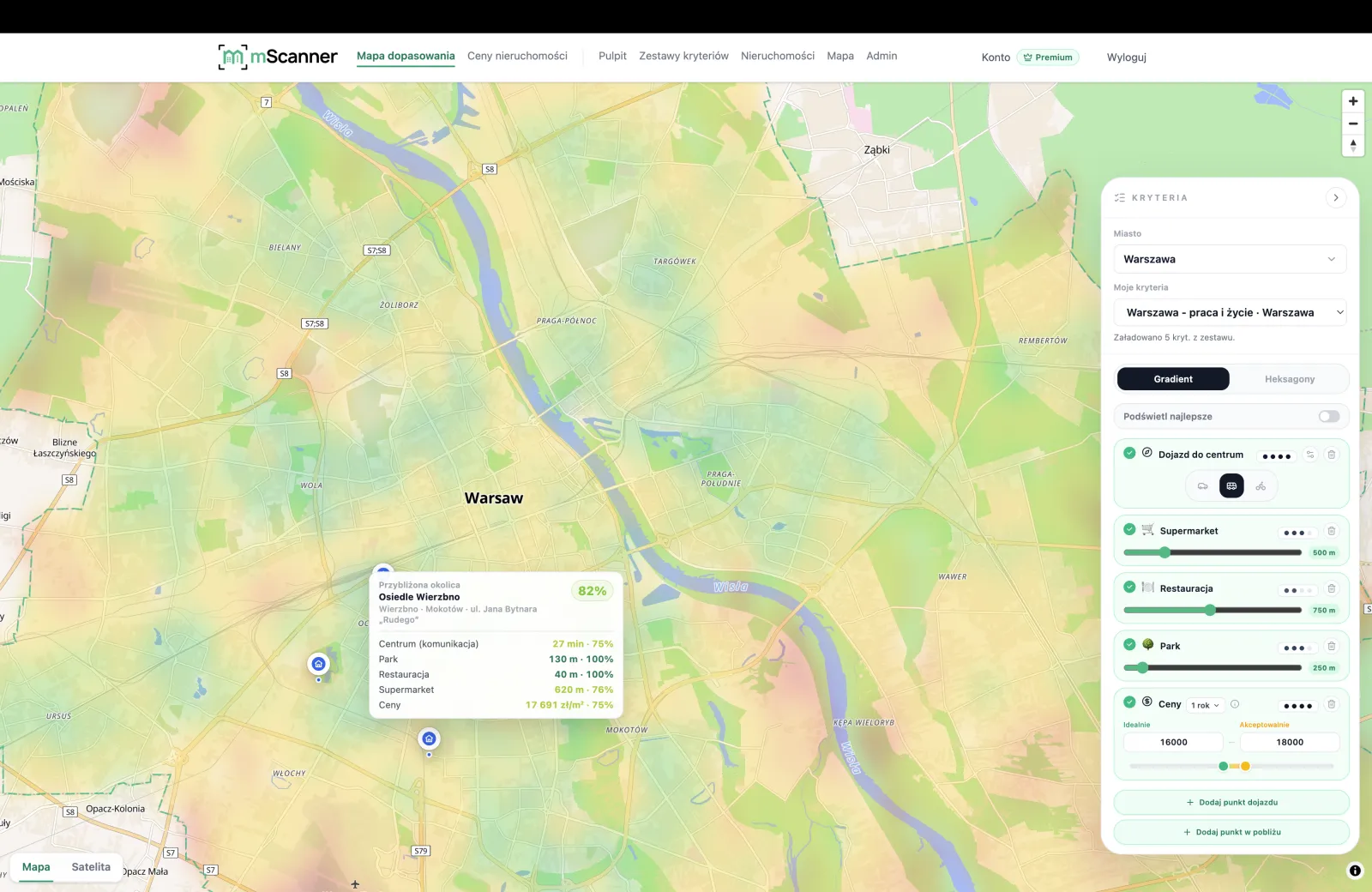
In mScanner you can pick location criteria and check which areas best fit your needs. It is then worth setting the result against the price and the report for a specific address.
Frequently asked questions
How does mScanner help choose where to live in Poznan?
It helps compare specific addresses by commutes, services, greenery, noise, the zoning plan, prices and your own location criteria.
Does mScanner replace viewing a flat?
No. mScanner helps organise the most important questions before deciding, but viewings, documents and professional checks are still needed.
Is it worth comparing several flats at once?
Yes. Comparing several saved flats helps you see whether you are paying extra for a real location advantage or just for the wording of the listing.
Which districts in Poznan are the greenest?
It depends on how close to a park, forest or water you want to live and which way you travel day to day. Instead of a generic ranking, the mScanner city heatmap scores areas by real access to greenery — set that criterion and see which addresses come out best for you.
Where in Poznan are the cheaper districts?
The lowest price per m² is not always the best choice — a cheap address can be far from work or services. The price map shows the price distribution, and the city heatmap sets price against the commute and surroundings, so you do not save at the cost of your daily commute.
Where to live in Poznan for a good commute to work or the centre?
Start with the question: by car or transit, and at what hours? The city heatmap computes the travel time from each area to the points you choose — work, school or the centre — so instead of guessing you see which districts give a fast commute on your routes.
How do I find a quiet, calm district in Poznan?
Quiet depends on more than the absence of a busy street — proximity to large developments and the building plan matter too. The city heatmap factors in a noise criterion, and the address report shows the zoning plan and surroundings, so you can check whether the calm is lasting.
Which district in Poznan is best for a family, a single person or a student?
There is no single best district — a family values schools, quiet and greenery, a single person values proximity to the centre and transport, and a student values rent and the commute to campus. In the city heatmap you set the weights of these criteria and get a result tailored to your profile.