Districts and neighbourhoods in Lublin
Lublin is divided into 27 administrative districts, though in practice the choice of neighbourhood comes down to a handful of areas: the historic centre (Stare Miasto, Śródmieście, Wieniawa), large-panel prefab estates in the west and north (Czuby, Rury/LSM, Czechów), leafy, residential suburbs (Sławin, Węglin), and riverside and post-industrial areas along the Bystrzyca (Tatary, Wrotków, Kalinowszczyzna). Below are the most important of these, with a frank look at the character of their built fabric and surroundings.
Stare Miasto
The historic core of the city, with its market square, castle, and dense tenement fabric within the old town walls; one of the least populous districts (around 2,400 residents). Housing consists mainly of restored tenements, with many units given over to restaurants and cultural venues. Full of character and prestige, but cramped, noisy, and with very limited parking.
Suitsthose who prize the atmosphere of a historic townscape and want to live at the very heart of the city
Śródmieście
The city centre proper, with the Krakowskie Przedmieście pedestrian street, Plac Litewski, the Saxon Garden, and 19th-century tenements. The greatest concentration of institutions, shops, restaurants, and public transport hubs in the city. Exceptionally walkable and well connected, but prices are higher, there is background noise, and parking is scarce.
Suitsthose who want everything within walking distance and enjoy the pace of city life
Wieniawa
A district along Aleja Racławickie that blends older housing stock, residential blocks, and a university campus; the Catholic University of Lublin (KUL) and the city's main stadium are located here. Its eastern edge meets the Saxon Garden, and Arena Lublin, Aqua Lublin, and Park Ludowy on the Bystrzyca are all close by. Central position and good transport links, though busy main roads and a varied, at times dense, built environment.
Suitsstudents, academic staff, and anyone who wants to live close to the city centre
Rury (LSM)
The most populous district in Lublin, commonly known as LSM (Lubelska Spółdzielnia Mieszkaniowa); modernist residential blocks have been delivered here since 1959. A green ravine running through the district is home to Park Rury and a cycle path, while the Lublin University of Technology campus on Nadbystrzycka is close by. A mature, well-ordered cooperative estate near the centre, though the housing stock is predominantly older blocks.
Suitsthose who value established estates with green space and proximity to the centre
Czuby
A large cluster of estates in the west of the city (Czuby Północne and Czuby Południowe) with a compact multi-family built environment from the 1970s and 1980s — individual estates bear names such as Ruta, Łęgi, Skarpa, Widok, and Błonie. A green ravine runs through the district, landscaped as Park Jana Pawła II. A self-contained, residential neighbourhood with retail and services on the doorstep, though it is further from the city centre and dominated by large-panel prefab blocks.
Suitsfamilies looking for a large estate with full amenities and green space
Czechów
A sprawling residential district in the north (Czechów Północny and Czechów Południowy), composed mainly of large-panel prefab blocks; individual estates are named after Polish composers — Chopina, Paderewskiego, Szymanowskiego. The district is criss-crossed by wide dual-carriageway roads and served by hypermarkets and retail parks. To the east lie the extensive Górki Czechowskie — a former military training ground with loess ravines and wild greenery. Convenient for drivers, but unmistakably a block-heavy neighbourhood.
Suitsfamilies who value a plentiful supply of flats and good road connections
Sławin
A district in the north-west of the city with a predominantly residential and recreational character, featuring a high proportion of detached houses and new developer-built estates. The UMCS Botanical Garden and the Museum of the Lublin Village (an open-air skansen) are located here, and walking trails lead towards Nałęczów and Kazimierz Dolny. Quieter and greener than the centre, but further from the city and more dependent on a car.
Suitsthose who value peace, greenery, and detached-house living
Węglin
A residential district in the south-west, divided by Aleja Kraśnicka into Węglin Północny and Węglin Południowy; terraced houses, semi-detached homes, and detached villas predominate. On the fringes of Węglin Południowy, newer developer-built flatted blocks are beginning to appear. A quiet, low-key area, though peripheral and with fewer local services than the central districts.
Suitsfamilies looking for a quiet neighbourhood with detached and semi-detached housing
Konstantynów
A mixed district in the south-west along Aleja Kraśnicka, combining detached houses, 1970s blocks, university and sports facilities, and new residential developments. The UMCS and KUL campuses are close by, making the area convenient for students. Good access to universities and a varied character, but an uneven built environment and a busy main road running through it.
Suitsstudents and those investing in buy-to-let property near the universities
Kalinowszczyzna
A densely populated district to the north-east of the centre, with blocks from the 1960s and 1970s supplemented by newer developer-built housing. It sits above the Bystrzyca valley, close to the castle hill, and is home to a historic old Jewish cemetery. Good access to the centre and a sound road network, though much of the housing stock is older and blocky.
Suitsthose who want to be close to the centre and the river valley at an accessible price
Bronowice
A district on the right bank of the Bystrzyca with suburban roots, featuring ZOR blocks from the 1950s and 1960s alongside detached housing. The historic 19th-century Park Bronowicki lies within its boundaries. Close to the city centre and Park Ludowy, though part of the housing stock is older and adjoins post-industrial land.
Suitsthose looking for an affordable, well-connected neighbourhood near the centre
Tatary
A post-industrial district in the east along the Bystrzyca, where a wartime lorry factory spawned the ZOR Tatary and Motor housing estates; tall large-panel prefab blocks from the 1970s dominate. Parts of the former factory complex have gone or changed use. Affordable and well placed for routes out of the city to the east, but the surroundings retain an industrial feel and the housing stock is dated.
Suitsthose looking for affordable flats with easy access to the eastern exits of the city
Dziesiąta
A district in the south with a distinctive mix of inter-war detached housing (a street layout inspired by the garden-city ideas of the 1920s and 1930s) and later large-panel prefab blocks. A quiet, residential area with its own historic street pattern. The older part has a village-like, intimate feel, but the overall built environment is uneven and the city centre is some distance away.
Suitsthose who appreciate an intimate, rooted neighbourhood with a mix of houses and flats
Wrotków
A district in the south with a mixed character: flatted estates (including the Nałkowskich estate) and detached housing in the west, with an industrial zone containing the combined heat and power plant to the north and east. The Zalew Zemborzycki reservoir and Las Dąbrowa — the city's largest recreational areas — are close by. Access to water and woodland is a genuine asset, but the proximity of industry and the peripheral location are trade-offs.
Suitsthose who value being close to the reservoir, the forest, and water-based recreation
Felin
A relatively new district on the eastern outskirts, along the road to Świdnik, with a mixed residential and academic character. The University of Life Sciences occupies experimental fields and student halls here, while a Lublin sub-zone of a special economic zone brings factories and logistics operations. New developer-built estates are appearing (including Nowy Felin). A dynamic, growing edge-of-city location with employment nearby, though far from the centre.
Suitsthose working in the east of the city who want a newly built home
Sławinek
A small, green district between Wieniawa and Sławin, bordering the UMCS Botanical Garden and the valley greenway. A mix of older detached housing and newer developer-built properties, fairly densely occupied given its modest size. Close to green space and not far from the centre, though the supply of available homes is limited.
Suitsthose who want to be near green space whilst keeping reasonable access to the centre
Ponikwoda
A spacious district in the north-east, formerly suburban and now dominated by detached housing supplemented by new developer-built estates. Low population density and plentiful green space give it a quiet, unhurried character. Peaceful and uncluttered, but peripheral and with fewer local services than the central districts.
Suitsthose who value quiet and detached-house living away from the bustle
These descriptions are informational — the best district depends on your criteria. Score the district match on the map →
How to choose a location
The question is whether an address fits your day, not only where it's cheaper. mScanner helps analyse a location in Lublin through concrete criteria, not through a district's general reputation.
First it is worth deciding what matters most to you: the commute, quiet, greenery, schools, services, transport or quick access to the centre.
Local differences in Lublin
When choosing a flat, compare areas such as Śródmieście, Stare Miasto, Wieniawa, Czechów, Czuby, Rury, LSM, Kalinowszczyzna, Bronowice and Tatary. Each of them can look different on the commute, services, greenery, noise and price.
Lublin is worth comparing with Świdnik, Lubartów, Łęczna and Niemce near Lublin. The outskirts can buy more space, but you have to check the bus or car commute and the everyday services.
Commutes
A commute is best measured to specific places, not just to the centre. For one person the best address is near a stop, for another near a good motorway access or a school.
Being close to a trolleybus or bus line and the bypass can change how an address reads more than the raw distance to the centre. Some people also commute to Świdnik or towards the airport.
Greenery and recreation
Proximity to greenery affects daily life, but the distance to a park alone is not enough. It is worth checking the real access to walking, waterside and recreation areas.
Nearby services
Shops, nurseries, schools, clinics and everyday service points can save more time than a few minutes saved on the commute to the centre.
Noise and surroundings
Noise, busy streets, proximity to large developments and the character of the buildings are worth assessing before you decide on a flat — whether you are buying or renting.
The zoning plan (MPZP) and the area plan
The local zoning plan (MPZP) and the urban surroundings help you understand what might be built nearby and whether the current view from the window is a lasting feature of the location.
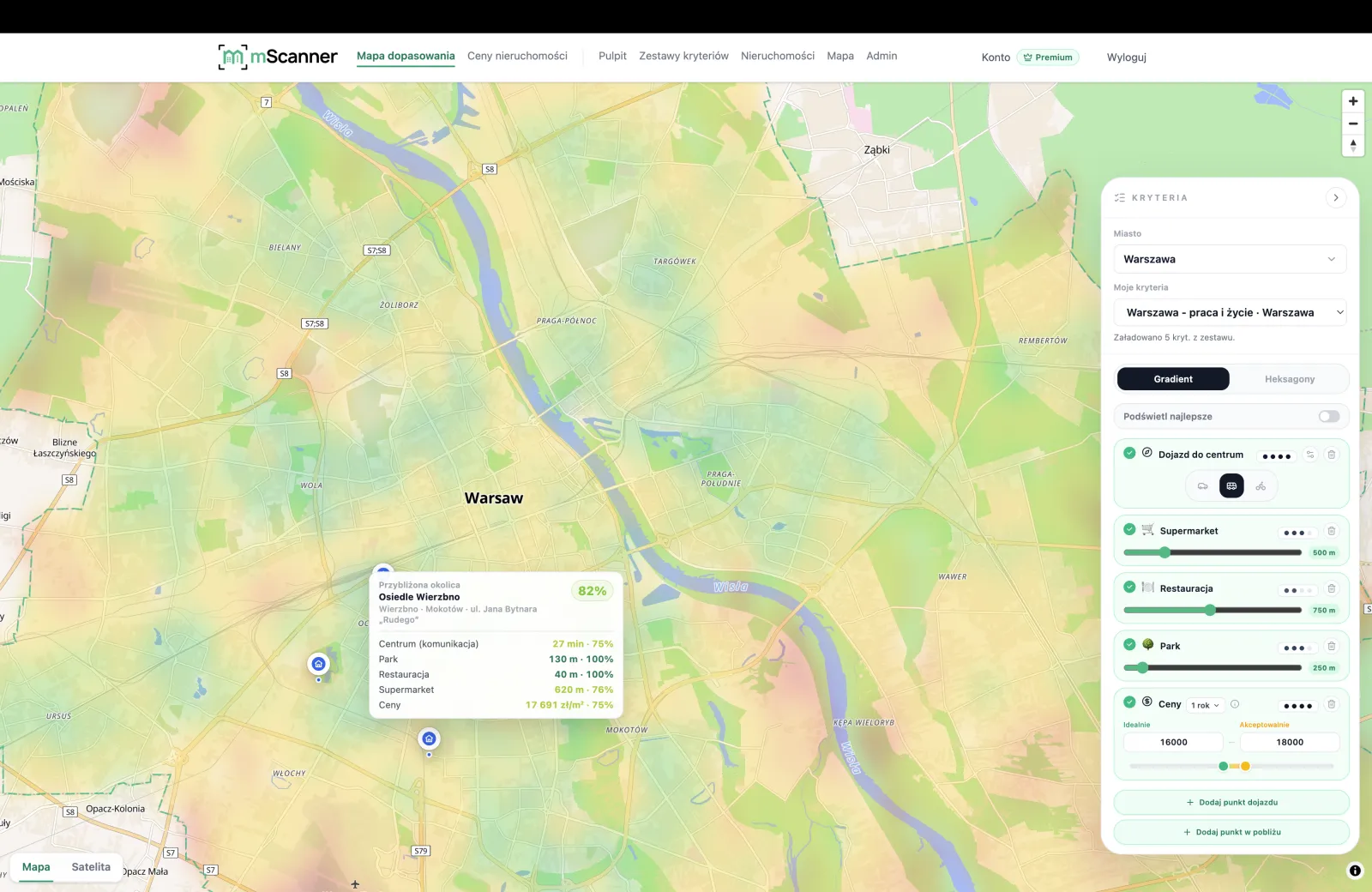
How to use the mScanner city heatmap
In mScanner you can pick location criteria and check which areas best fit your needs. It is then worth setting the result against the price and the report for a specific address.
Frequently asked questions
How does mScanner help choose where to live in Lublin?
It helps compare specific addresses by commutes, services, greenery, noise, the zoning plan, prices and your own location criteria.
Does mScanner replace viewing a flat?
No. mScanner helps organise the most important questions before deciding, but viewings, documents and professional checks are still needed.
Is it worth comparing several flats at once?
Yes. Comparing several saved flats helps you see whether you are paying extra for a real location advantage or just for the wording of the listing.
Which districts in Lublin are the greenest?
It depends on how close to a park, forest or water you want to live and which way you travel day to day. Instead of a generic ranking, the mScanner city heatmap scores areas by real access to greenery — set that criterion and see which addresses come out best for you.
Where in Lublin are the cheaper districts?
The lowest price per m² is not always the best choice — a cheap address can be far from work or services. The price map shows the price distribution, and the city heatmap sets price against the commute and surroundings, so you do not save at the cost of your daily commute.
Where to live in Lublin for a good commute to work or the centre?
Start with the question: by car or transit, and at what hours? The city heatmap computes the travel time from each area to the points you choose — work, school or the centre — so instead of guessing you see which districts give a fast commute on your routes.
How do I find a quiet, calm district in Lublin?
Quiet depends on more than the absence of a busy street — proximity to large developments and the building plan matter too. The city heatmap factors in a noise criterion, and the address report shows the zoning plan and surroundings, so you can check whether the calm is lasting.
Which district in Lublin is best for a family, a single person or a student?
There is no single best district — a family values schools, quiet and greenery, a single person values proximity to the centre and transport, and a student values rent and the commute to campus. In the city heatmap you set the weights of these criteria and get a result tailored to your profile.