Districts and neighbourhoods in Lodz
Łódź is commonly divided into five areas: the city centre proper with Piotrkowska Street, and four historic districts encircling it — Bałuty to the north, Polesie to the west, Widzew to the east, and Górna to the south. Each has its own character: from central tenements and large-panel prefab blocks to leafy villa districts and suburban housing estates.
Śródmieście
The city centre proper, home to Piotrkowska Street (the longest pedestrian high street in Poland), Manufaktura in the former Poznański factory complex, and OFF Piotrkowska. The area is dominated by dense 19th-century tenement fabric — some beautifully restored after regeneration works, others still awaiting renovation. Everything is within walking distance, served by a dense network of trams and buses.
Suitsthose who enjoy urban living, dining out, and getting around without a car
Nowe Centrum ŁodziŚródmieście
A major regeneration zone centred on the underground Łódź Fabryczna railway station and the EC1 cultural centre in a former power station. New developer-built blocks referencing tenement and post-industrial architecture are rising on the edge of the city centre and former railway land. The area is a key interchange hub for national rail, ŁKA commuter rail, trams, and buses.
Suitsthose wanting a new-build flat in the centre with a railway station on the doorstep
Stare PolesiePolesie
One of the oldest parts of the city, lying just west of Piotrkowska and built almost entirely of tenements, next to Sienkiewicz Park. Regeneration is under way — façade restoration, shared-street schemes, and new planting — though the condition of buildings remains uneven. The city centre is easily reached on foot or by tram.
Suitsthose who love the tenement atmosphere and want to be close to the centre
RetkiniaPolesie
One of the largest large-panel prefab block estates in Łódź, built from the 1970s onwards for nearly 80,000 residents. A self-contained dormitory neighbourhood with a good tram network (including lines 10 and 14) and proximity to Park na Zdrowiu. Plenty of green space between the blocks, though it is a fair distance from the city centre.
Suitsthose looking for an affordable, well-connected flat in a prefab block
KarolewPolesie
An estate of four- and ten-storey blocks from the 1960s and early 1970s, with a scattering of tenements and detached houses. It borders Piłsudski Park (Park na Zdrowiu) and has its own tram terminus served by several lines including 10, 12, and 14. A quiet, dormitory neighbourhood with good access to green space.
Suitsfamilies who value living beside a park with reliable tram connections
Zdrowie-ManiaPolesie
An area dominated by Piłsudski Park (Park na Zdrowiu) — the largest municipal park in Łódź — along with the Botanical Garden, Orientarium Zoo, and the Fala aquapark. Residential development here is scattered and surrounded by greenery and the Polesie Konstantynowskie nature reserve. Abundant leisure facilities, though this is very much the edge of the city.
Suitsactive residents and families who want a park and a swimming pool around the corner
Bałuty CentrumBałuty
The most populous estate in the old Bałuty district, north of the centre, with the characteristic mix of old tenements, houses, and blocks alongside Bałuty Market with its large covered hall. The building stock can be run-down and in need of renovation, but the area is close to the centre and well served by trams.
Suitsthose looking for affordability close to the centre and willing to accept an uneven standard of housing
DołyBałuty
An estate built in the 1950s and 1960s in the northern part of the city, predominantly four-storey blocks supplemented by taller apartment buildings, houses, and tenements. Nearby is the large Doły cemetery complex, as well as parks and green areas. A quiet, urban neighbourhood with good access to the city centre.
Suitsthose looking for a calmer, greener neighbourhood within reach of the centre
RadogoszczBałuty
A northern Bałuty estate on the border with Zgierz, whose core consists of two 1980s large-panel prefab developments (Wschód and Zachód) separated by Zgierska Street. Detached and terraced houses (Helenówek, Liściasta) appear on the fringes. A dormitory neighbourhood far from the centre but peaceful.
Suitsthose looking for a flat in a block away from the hustle of the city centre
TeofilówBałuty
A large-panel prefab estate from the 1960s and 1970s in the western part of Bałuty, with five-storey blocks and ten- to eleven-storey towers. Across Aleksandrowska Street lies Teofilów Przemysłowy with former industrial works. A classic dormitory estate with complete local amenities, though quite some distance from the centre.
Suitsthose in search of a typical, well-equipped prefab-block estate
JulianówBałuty
The villa quarter of Bałuty — a leafy, intimate area developed from the interwar period onwards with detached houses and villas, including a Modernist housing estate built for civil servants. It borders Julianów Park (named after Mickiewicz), with the Sokołówka and Brzoza rivers running through it. Quiet and green, though further from the centre and priced accordingly.
Suitsthose who value peace, greenery, and a villa-style neighbourhood
MarysinBałuty
An estate in the north-eastern part of Bałuty, bordering Łagiewniki Forest — one of the largest urban forests in Poland. The housing mix is varied: detached houses, tenements, older blocks, and new developer-built schemes. One of the greener and quieter parts of the city, though on the outskirts.
Suitsthose who value proximity to the forest and a peaceful, low-rise setting
Widzew-WschódWidzew
One of Łódź's younger estates, built mainly in the late 1970s and 1980s from large-panel prefab blocks (Batorego, Chrobrego, and Mieszka I estates), now complemented by new apartment buildings. The Łódź Widzew railway station is nearby, alongside tram depots and several lines. A well-connected dormitory neighbourhood on the eastern side of the city.
Suitscommuters who rely on rail and value good public-transport links
ZarzewWidzew
An estate in southern Widzew, laid out on former fields and meadows without the industrial legacy that characterises much of the district. Blocks from the 1970s and later predominate; detached houses are few. Nearby is Podolski Park on the Dąbrówka river, with a salt graduation tower (tężnia); the main artery is Przybyszewskiego Street.
Suitsthose looking for a flat with a park and a salt graduation tower close by
Olechów-JanówWidzew
An estate in the eastern part of the city where 1980s large-panel prefab blocks are interspersed with later multi-family development from the turn of the millennium and a growing number of new-build schemes. Bus and tram connections link the area to the centre. A relatively new and expanding dormitory neighbourhood, though far from the city centre.
Suitsthose looking for a new-build flat at an accessible price
Chojny-DąbrowaGórna
A large residential estate in the south of the city, built in the 1960s and 1970s, much of it using the "Dąbrowa" large-panel prefab system (recognisable by its characteristically low window bands). Planned for around 50,000 residents and equipped with a full range of local amenities. A typical dormitory estate with good transport links, though far from the centre.
Suitsthose looking for an affordable flat in a southern block estate
RudaGórna
The former village of Ruda Pabianicka in the south-west of the city, with a villa estate on the site of a former horse-racing track and wooden leisure villas near Ruda-Popioły Forest. Stefański Ponds with their recreation park are close by. Green, peaceful, and villa-like in character, though firmly on the city's periphery.
Suitsthose who value a villa-style setting with forest and water on the doorstep
RokicieGórna
An estate in the south-west of the former Górna district where the southern section is dominated by detached houses and low-rise development (generally up to four storeys). New multi-family schemes and terraced houses are appearing on previously undeveloped land along the Jasień river. A quiet neighbourhood with a varied, low-rise character.
Suitsthose who value low-rise development, a peaceful setting, and a detached house within reach
These descriptions are informational — the best district depends on your criteria. Score the district match on the map →
How to choose a location
The question is whether an address fits your day, not only where it's cheaper. mScanner helps analyse a location in Lodz through concrete criteria, not through a district's general reputation.
First it is worth deciding what matters most to you: the commute, quiet, greenery, schools, services, transport or quick access to the centre.
Local differences in Lodz
When choosing a flat, compare areas such as Śródmieście, Nowe Centrum Łodzi, Stare Polesie, Retkinia, Karolew, Zdrowie-Mania, Bałuty Centrum, Doły, Radogoszcz and Teofilów. Each of them can look different on the commute, services, greenery, noise and price.
Łódź is worth comparing with Pabianice, Zgierz, Aleksandrów Łódzki, Konstantynów Łódzki, Rzgów and Stryków. The outskirts can be cheaper or buy more space, but the ŁKA, the roads and the commute to work are decisive.
Commutes
A commute is best measured to specific places, not just to the centre. For one person the best address is near a stop, for another near a good motorway access or a school.
The commute to the centre, a university or work can be good from several directions, but you have to check the specific stop and the real route.
Greenery and recreation
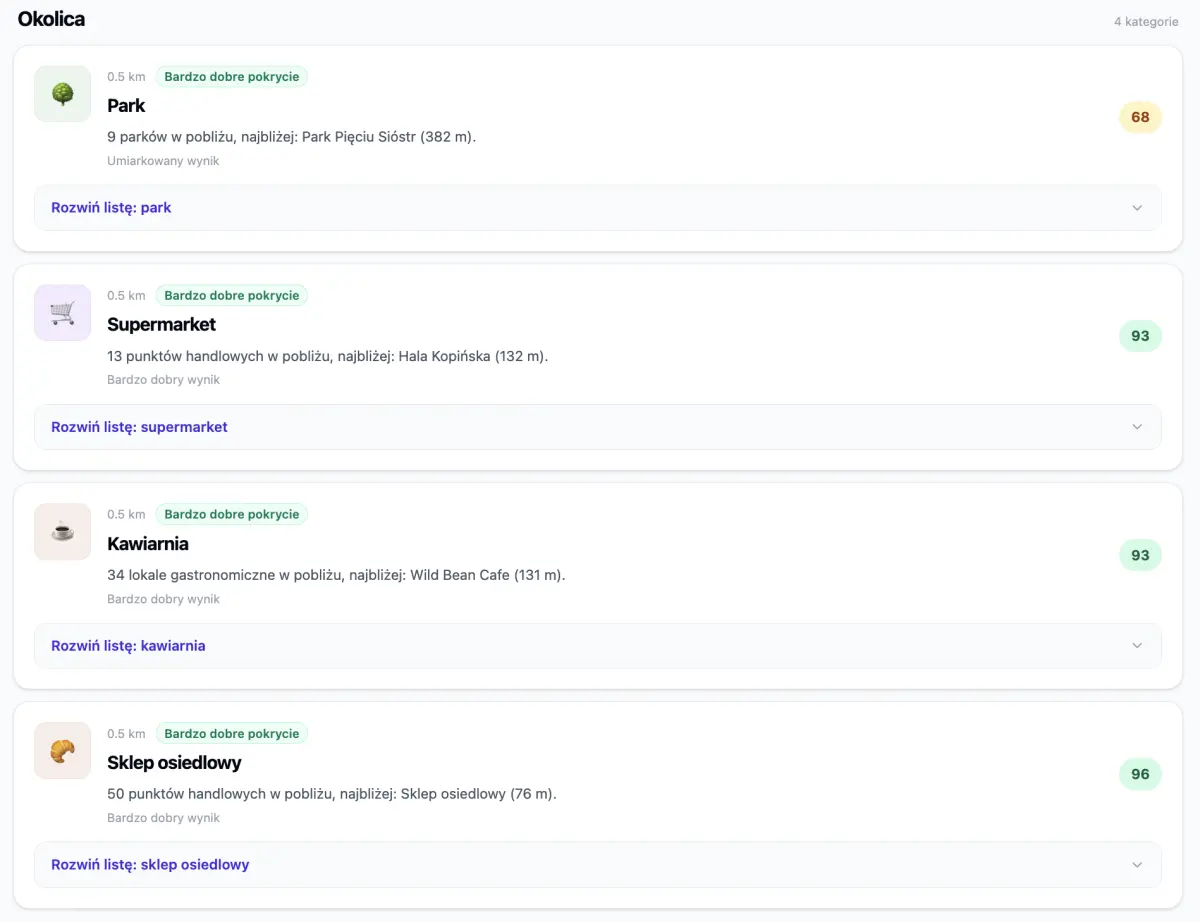
Proximity to greenery affects daily life, but the distance to a park alone is not enough. It is worth checking the real access to walking, waterside and recreation areas.
Nearby services
Shops, nurseries, schools, clinics and everyday service points can save more time than a few minutes saved on the commute to the centre.
Noise and surroundings
Noise, busy streets, proximity to large developments and the character of the buildings are worth assessing before you decide on a flat — whether you are buying or renting.
The zoning plan (MPZP) and the area plan
The local zoning plan (MPZP) and the urban surroundings help you understand what might be built nearby and whether the current view from the window is a lasting feature of the location.
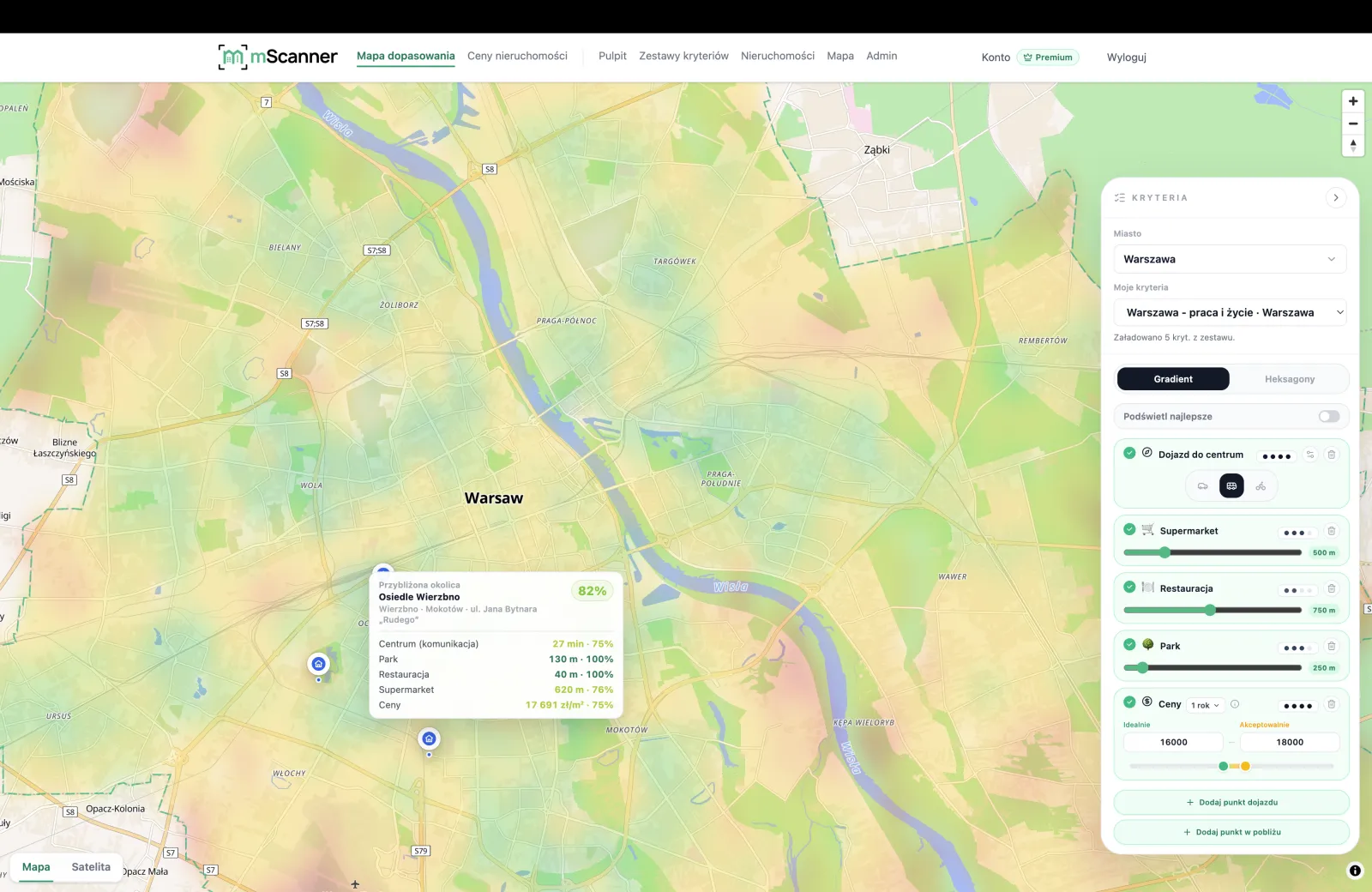
How to use the mScanner city heatmap
In mScanner you can pick location criteria and check which areas best fit your needs. It is then worth setting the result against the price and the report for a specific address.
Frequently asked questions
How does mScanner help choose where to live in Lodz?
It helps compare specific addresses by commutes, services, greenery, noise, the zoning plan, prices and your own location criteria.
Does mScanner replace viewing a flat?
No. mScanner helps organise the most important questions before deciding, but viewings, documents and professional checks are still needed.
Is it worth comparing several flats at once?
Yes. Comparing several saved flats helps you see whether you are paying extra for a real location advantage or just for the wording of the listing.
Which districts in Lodz are the greenest?
It depends on how close to a park, forest or water you want to live and which way you travel day to day. Instead of a generic ranking, the mScanner city heatmap scores areas by real access to greenery — set that criterion and see which addresses come out best for you.
Where in Lodz are the cheaper districts?
The lowest price per m² is not always the best choice — a cheap address can be far from work or services. The price map shows the price distribution, and the city heatmap sets price against the commute and surroundings, so you do not save at the cost of your daily commute.
Where to live in Lodz for a good commute to work or the centre?
Start with the question: by car or transit, and at what hours? The city heatmap computes the travel time from each area to the points you choose — work, school or the centre — so instead of guessing you see which districts give a fast commute on your routes.
How do I find a quiet, calm district in Lodz?
Quiet depends on more than the absence of a busy street — proximity to large developments and the building plan matter too. The city heatmap factors in a noise criterion, and the address report shows the zoning plan and surroundings, so you can check whether the calm is lasting.
Which district in Lodz is best for a family, a single person or a student?
There is no single best district — a family values schools, quiet and greenery, a single person values proximity to the centre and transport, and a student values rent and the commute to campus. In the city heatmap you set the weights of these criteria and get a result tailored to your profile.