
Districts and neighbourhoods in Gdansk
Gdańsk stretches from the coastal belt and the historic centre along the Motława river to the large-panel prefab estates and new developments of the Górny Taras plateau in the south. In practice the choice comes down to three zones: the heritage Śródmieście, the coastal axis of Wrzeszcz–Oliwa–Przymorze, and the cheaper, more residential southern districts.
Główne MiastoŚródmieście
The grand, tourist-facing heart of the city: post-war reconstruction in Gothic and Dutch Renaissance style along Długi Targ, ul. Mariacka, dominated by St Mary's Basilica and the Crane over the Motława. Flats are found mainly in restored tenements, with ground-floor retail and restaurants throughout.
Suitsthose who value living in a historic centre close to restaurants and accept the bustle and tourist footfall
Stare MiastoŚródmieście
The part of Śródmieście north of Główne Miasto, home to the Old Town Hall, the Great Mill and the Main Market Hall — quieter and far less crowded than Długi Targ. The built fabric is a mix of tenements, post-war infill and newer developments.
Suitsthose who want a central address but a little distance from the main tourist promenade
Młode MiastoŚródmieście
A growing quarter on the former Gdańsk Shipyard site, next to the European Solidarity Centre, where the large-scale Doki mixed-use scheme (over 1,000 flats plus retail) is taking shape. New-build apartments among preserved shipyard structures, with views across to Główne Miasto.
Suitsthose looking for a new-build flat in the centre within a post-industrial, still-evolving setting
Wrzeszcz DolnyWrzeszcz
A blend of late-19th- and early-20th-century tenements (around ul. Wajdeloty), the new Garnizon estate on a former barracks site, and major retail and office buildings (Bałtycka, Manhattan, Metropolia). Gdańsk Wrzeszcz station serves SKM, PKP and PKM; nearby are Park Kuźniczki and a riverside promenade along the Strzyża.
Suitsthose who appreciate an urban atmosphere, good amenities and fast rail access to the centre and Gdynia
Wrzeszcz GórnyWrzeszcz
A highly varied built environment: historic villas, pre-war tenements, 1990s blocks and pockets of large-panel prefab. The campus of Gdańsk University of Technology is here, as is Jaśkowa Dolina — one of the oldest public parks in Europe.
Suitsstudents, university staff and those who want greenery on the doorstep without giving up an urban feel
Oliwa
A historic district with the Oliwa Archcathedral and its famous organ, the extensive Oliwa Park, the zoo and elegant villas along ul. Polanki, backed by the forested hills of Trójmiejski Landscape Park (Pachołek). The University of Gdańsk campus is also here; good connections by SKM and tram.
Suitsfamilies and those who prize quiet, greenery and easy access to the forest, and are willing to pay for it
Przymorze WielkiePrzymorze
A densely built coastal district from the 1960s and 70s, defined by its iconic wavy apartment blocks — one of them nearly a kilometre long. More recent high-rises have since joined them. On site are the Reagan Nadmorski Park with direct beach access and Galeria Przymorze; served by SKM and tram.
Suitsthose who want to be close to the beach and coastal park and are comfortable with a classic large-panel prefab setting
Zaspa
A large-panel prefab estate from the 1970s and 80s laid out on a former airport, with a distinctive honeycomb arrangement of blocks set amid generous green space. It is renowned for its Collection of Monumental Painting — dozens of murals on block facades along ul. Pilotów. On site: Jan Paweł II Park; served by SKM and tram.
Suitsthose looking for a green, well-connected estate close to the coastal belt
ŻabiankaŻabianka-Wejhera-Jelitkowo-Tysiąclecia
A large-panel prefab estate on the border with Sopot, with plenty of greenery and a pedestrian boulevard linking SKM Gdańsk Żabianka AWFiS station to ul. Gospody. Close to the AWFiS sports academy, the Jelitkowo beach and the Nadmorski Park.
Suitsthose who want to be near Sopot and the beach with quick SKM access
JelitkowoŻabianka-Wejhera-Jelitkowo-Tysiąclecia
A quiet, intimate coastal neighbourhood on the Sopot boundary, with a beach stretching all the way to the Sopot border and the 19th-century Jelitkowski Park. Low-rise, partly villa and guesthouse development that draws large summer crowds.
Suitsthose who want to be directly on the sea in a relaxed, resort-like setting
Brzeźno
A seaside district with a pier, bathing area, wide beach and a coastal park rooted in its 19th-century spa heritage. The built fabric is varied — older tenements and houses alongside newer developments; served by trams 3 and 5 and bus 62.
Suitsthose who enjoy a coastal, walkable atmosphere with beach and pier access
Piecki-Migowo (Morena)
A residential district on the moraine hills of the Górny Taras plateau (up to around 122 m above sea level), with forests and ponds, built out mainly in the 1970s and 80s with large-panel prefab and supplemented by later blocks. The main spine is ul. Rakoczego; trams 10 and 12 have served the area since 2015, and PKM Brętowo station and the Gdańsk Science and Technology Park are nearby.
Suitsfamilies who want greenery and peace away from the centre, with tram and PKM connections
Jasień
A rapidly growing district in southern Gdańsk where new developer schemes dominate, filling in around earlier buildings. A 77-hectare Southern Park is taking shape on the border with Ujeścisko; a new tram line is under construction and a Gdańsk South–Wrzeszcz tramway route is planned.
Suitsthose buying a new-build flat with an eye on improving transport links and a future park on the doorstep
Ujeścisko-Łostowice
A large, young residential district on the Górny Taras plateau — encompassing Ujeścisko, Zakoniczyn, Zaborne and Łostowice — where the oldest blocks are around 20 years old and new ones continue to be added. Al. Pawła Adamowicza with a tram line runs along the western edge; the Southern Park is being developed in the vicinity.
Suitsfamilies looking for newer housing in a quiet, still-growing area
Chełm
A large Górny Taras plateau district built out mainly in the 1970s and 80s — known in the Gierek era as 'Estate of the Year 2000' — supplemented by newer blocks. Predominantly residential in character; the planned PKM Południe rail extension (expected around 2029) will bring a Gdańsk Chełm station to the area.
Suitsthose looking for more affordable housing in a residential district with public transport access
Orunia Górna-Gdańsk Południe
A Górny Taras plateau estate where the first ten-storey blocks went up in the late 1960s and major development followed in the 1980s; new developer projects are now joining the mix. A tram interchange operates at the Łostowice-Świętokrzyska terminus; a PKM Południe stop at Gdańsk Orunia Górna is planned.
Suitsfirst-time buyers who prioritise lower prices and improving transport links
Osowa
A peripheral, predominantly villa district on the north-western edge of the city, with a mix of detached houses and newer estates surrounded by forests and lakes. It has its own railway station (PKM/SKM Gdańsk Osowa) but is relatively far from the centre.
Suitsfamilies seeking a house and quiet on the city's outskirts who are happy with a longer commute
These descriptions are informational — the best district depends on your criteria. Score the district match on the map →
How to choose a location
The question is whether an address fits your day, not only where it's cheaper. mScanner helps analyse a location in Gdansk through concrete criteria, not through a district's general reputation.
First it is worth deciding what matters most to you: the commute, quiet, greenery, schools, services, transport or quick access to the centre.
Local differences in Gdansk
When choosing a flat, compare areas such as Śródmieście, Główne Miasto, Młode Miasto, Wrzeszcz Dolny, Wrzeszcz Górny, Oliwa, Przymorze, Zaspa, Żabianka and Jelitkowo. Each of them can look different on the commute, services, greenery, noise and price.
Gdańsk is worth comparing with Gdynia, Sopot, Pruszcz Gdański and the districts along the SKM. If you commute to Gdynia or Sopot daily, the Gdańsk price alone is not enough to judge an offer.
Commutes
A commute is best measured to specific places, not just to the centre. For one person the best address is near a stop, for another near a good motorway access or a school.
An address near the SKM or a tram can be more practical than a similar offer further from the transport axis, even if it looks close to the centre on a map.
Greenery and recreation
Proximity to greenery affects daily life, but the distance to a park alone is not enough. It is worth checking the real access to walking, waterside and recreation areas.
Nearby services
Shops, nurseries, schools, clinics and everyday service points can save more time than a few minutes saved on the commute to the centre.
Noise and surroundings
Noise, busy streets, proximity to large developments and the character of the buildings are worth assessing before you decide on a flat — whether you are buying or renting.
The zoning plan (MPZP) and the area plan
The local zoning plan (MPZP) and the urban surroundings help you understand what might be built nearby and whether the current view from the window is a lasting feature of the location.
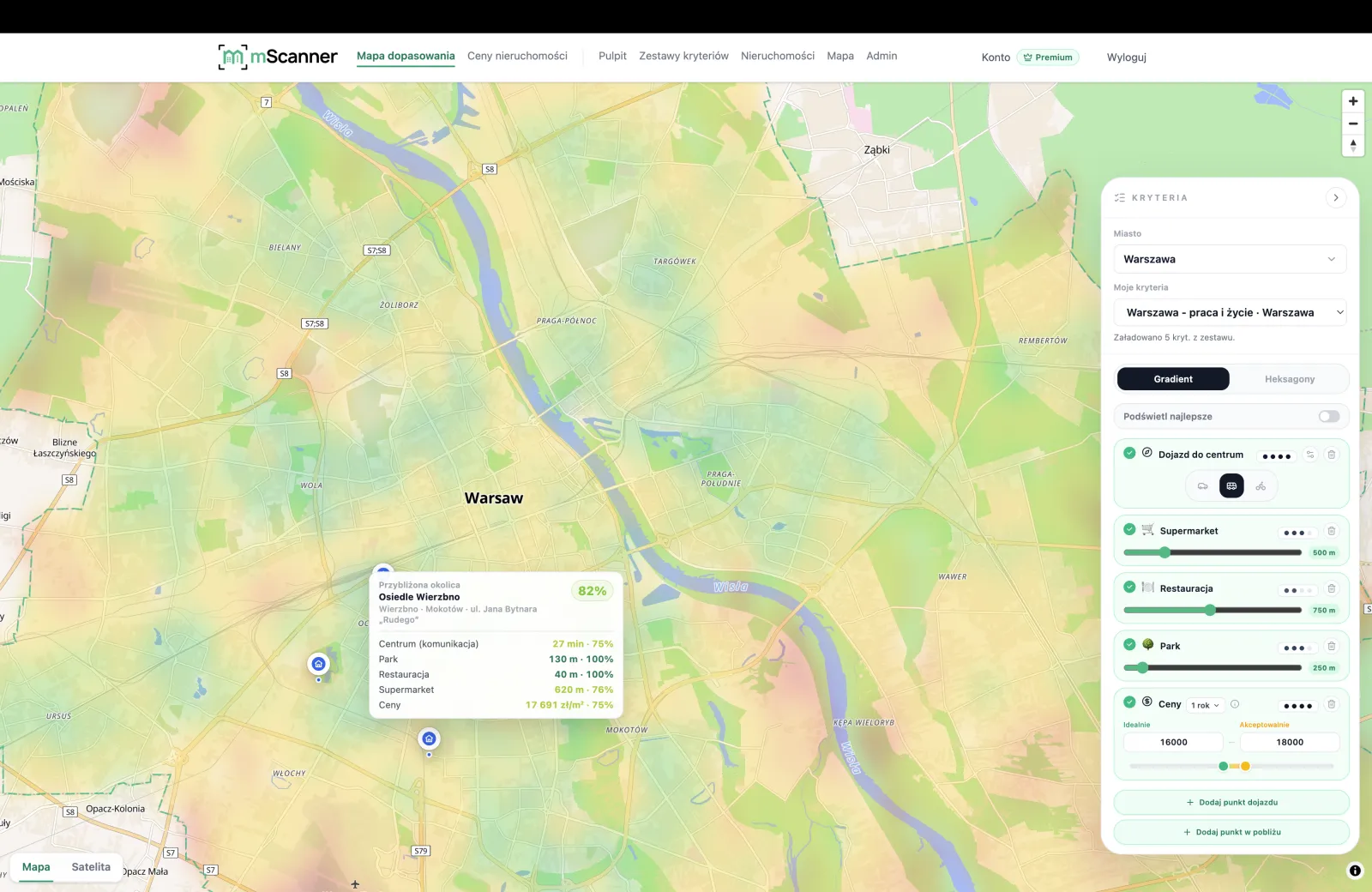
How to use the mScanner city heatmap
In mScanner you can pick location criteria and check which areas best fit your needs. It is then worth setting the result against the price and the report for a specific address.
Frequently asked questions
How does mScanner help choose where to live in Gdansk?
It helps compare specific addresses by commutes, services, greenery, noise, the zoning plan, prices and your own location criteria.
Does mScanner replace viewing a flat?
No. mScanner helps organise the most important questions before deciding, but viewings, documents and professional checks are still needed.
Is it worth comparing several flats at once?
Yes. Comparing several saved flats helps you see whether you are paying extra for a real location advantage or just for the wording of the listing.
Which districts in Gdansk are the greenest?
It depends on how close to a park, forest or water you want to live and which way you travel day to day. Instead of a generic ranking, the mScanner city heatmap scores areas by real access to greenery — set that criterion and see which addresses come out best for you.
Where in Gdansk are the cheaper districts?
The lowest price per m² is not always the best choice — a cheap address can be far from work or services. The price map shows the price distribution, and the city heatmap sets price against the commute and surroundings, so you do not save at the cost of your daily commute.
Where to live in Gdansk for a good commute to work or the centre?
Start with the question: by car or transit, and at what hours? The city heatmap computes the travel time from each area to the points you choose — work, school or the centre — so instead of guessing you see which districts give a fast commute on your routes.
How do I find a quiet, calm district in Gdansk?
Quiet depends on more than the absence of a busy street — proximity to large developments and the building plan matter too. The city heatmap factors in a noise criterion, and the address report shows the zoning plan and surroundings, so you can check whether the calm is lasting.
Which district in Gdansk is best for a family, a single person or a student?
There is no single best district — a family values schools, quiet and greenery, a single person values proximity to the centre and transport, and a student values rent and the commute to campus. In the city heatmap you set the weights of these criteria and get a result tailored to your profile.