Districts and neighbourhoods in Bialystok
Białystok is divided administratively into nearly 30 estates. In practice, the choice comes down to the city centre and its adjacent tenement-lined streets, the large-panel prefab blocks from the 1970s and 80s on the outer edges of the centre, and the newer developer-built estates and detached houses spreading across the west and south of the city.
Centrum
The historic and representative heart of the city, centred on Rynek Kościuszki and the Branicki Palace with its park (Branicki Gardens), the Planty promenades, and the main pedestrian street. A true city-centre streetscape: tenements, public buildings, offices, restaurants, and shops. The main bus interchange and most institutions are within easy walking distance.
Suitsthose who want fully urban living with everything on foot
Sienkiewicza
An estate just north of the centre dominated by four- and eleven-storey co-operative blocks (BSM) from the communist era, set along quieter streets yet right on the doorstep of the city centre. Rynek Kościuszki is an easy walk away.
Suitsthose who want to live in a block near the centre without the bustle of the pedestrian street
Bojary
An old inner-city district south of the centre preserving traditional timber houses (the so-called 'Boyar cottages'), rent-collecting tenements, and Modernist villas from the turn of the twentieth century and the interwar period. A characterful enclave with gardens, though part of the historic fabric is gradually giving way to new development.
Suitsthose who appreciate the character of old architecture close to the centre
Piaski
A district with a city-centre feel south of the centre, with listed tenements and villas along the elegant ul. Lipowa (lined with cafés and shops) and Plac Niepodległości. Home to Białystok University of Technology campuses and the university hospitals.
Suitsstudents, academic staff, and those buying to let near the centre
Przydworcowe
The estate around Białystok Główny railway station and the intermodal bus-and-rail interchange, hemmed in by a triangle of railway lines. A mix of historic tenements, older detached houses, and new apartment buildings; the area is undergoing intensive redevelopment into mixed residential and commercial use.
Suitscommuters who travel by rail and value an interchange on their doorstep
Antoniuk
A residential estate in the north-central part of the city, one of the older ones, developed from the 1960s onwards. The housing stock is a mixture of traditional blocks along ul. Narewska and ul. Antoniukowska and large-panel prefab blocks further inside the estate, now being supplemented by newer apartment buildings.
Suitsthose looking for a flat in a block near the centre in a well-established neighbourhood
Wysoki Stoczek
An estate with a mixed residential and industrial character in the north-west of the city, bordering the Biała river and al. Jana Pawła II. The built environment is varied — blocks, detached houses, and industrial land — giving it a utilitarian rather than polished feel.
Suitsthose looking for cheaper housing away from the city centre
Dziesięciny
A large large-panel prefab estate from the late 1970s and 80s, one of the most populous in the city, built on the site of a former village. Classic block housing (ul. Hallera is home to the longest block in the city) with lawns and playgrounds between buildings; well served by bus routes.
Suitsthose looking for affordable housing with a full range of estate amenities
Bacieczki
An estate in the western part of the city, in the Biała river valley, characterised by low-rise, intimate development: detached houses and smaller developer projects. Plenty of green space and newly built pockets of family homes, popular with families with children.
Suitsfamilies looking for quiet, low-rise surroundings and greenery
Białostoczek
An estate defined by railway lines, planned in the 1970s around a layout of 'colonies' separated by green space and playgrounds. Housing ranges from low-rise houses and terraces at the edges to three-, five-, and eleven-storey blocks in the centre; the blocks were deliberately set back from the tracks.
Suitsthose who appreciate a block estate with generous green space between buildings
Mickiewicza
An estate in the middle of the city, one of the few near the centre to offer predominantly lower-rise development with a good deal of greenery and ponds. Home to the University of Białystok campus, the Opera and Philharmonic of Podlaskie concert hall, Alfa and Atrium Biała shopping centres, and the nearby municipal stadium.
Suitsthose who value greenery and culture with good access to the centre
Nowe Miasto
A sprawling residential estate in the south of the city with a large stock of 1970s and 80s blocks supplemented by newer development. A typical dormitory neighbourhood with its own shops, schools, and green areas, within reach of the city centre by bus.
Suitsthose looking for a self-contained dormitory estate with all the basics
Starosielce
A former railway workers' town absorbed into Białystok in 1954, situated in the western part of the city. There is no single-block district feel here — it is a 'town within a town', with historic buildings, detached houses, blocks, factories, and railway sidings sitting side by side.
Suitsthose who want a homely, intimate neighbourhood with its own distinct identity
Dojlidy
The largest estate by area, on the south-eastern edge of the city, with a mixed residential and industrial character (home to the Dojlidy Brewery). It borders the Dojlidy Ponds and a reservoir with a municipal beach, surrounded by woodland and meadows. Development is mainly detached houses and recreational land by the water.
Suitsthose who value proximity to water, woodland, and leisure
Słoneczny Stok
A co-operative large-panel prefab estate built from the late 1970s, designed with care for green space and community facilities (including a cultural centre). The housing is varied in height — from low atrium houses to three-, five-, and eight-storey blocks — with generous green areas between buildings.
Suitsthose looking for a well-ordered estate with greenery and amenities
Leśna Dolina
An estate in the west of the city, built on the land of the former villages of Krupniki and Bacieczki from the turn of the 1990s. Its appearance sets it apart from its neighbours: instead of large-panel prefab, it features brick and postmodern block forms (notably along al. Niepodległości). Plenty of green space, including a woodland park in the making.
Suitsthose who prefer newer block-style development with access to green space
Zielone Wzgórza
A co-operative estate (part of the Słoneczny Stok cluster) in the west of the city, with blocks from the 1980s and 90s, well-kept green areas, and a range of local services. A quiet, typical residential neighbourhood away from the main arterial roads.
Suitsfamilies who value a peaceful estate with greenery
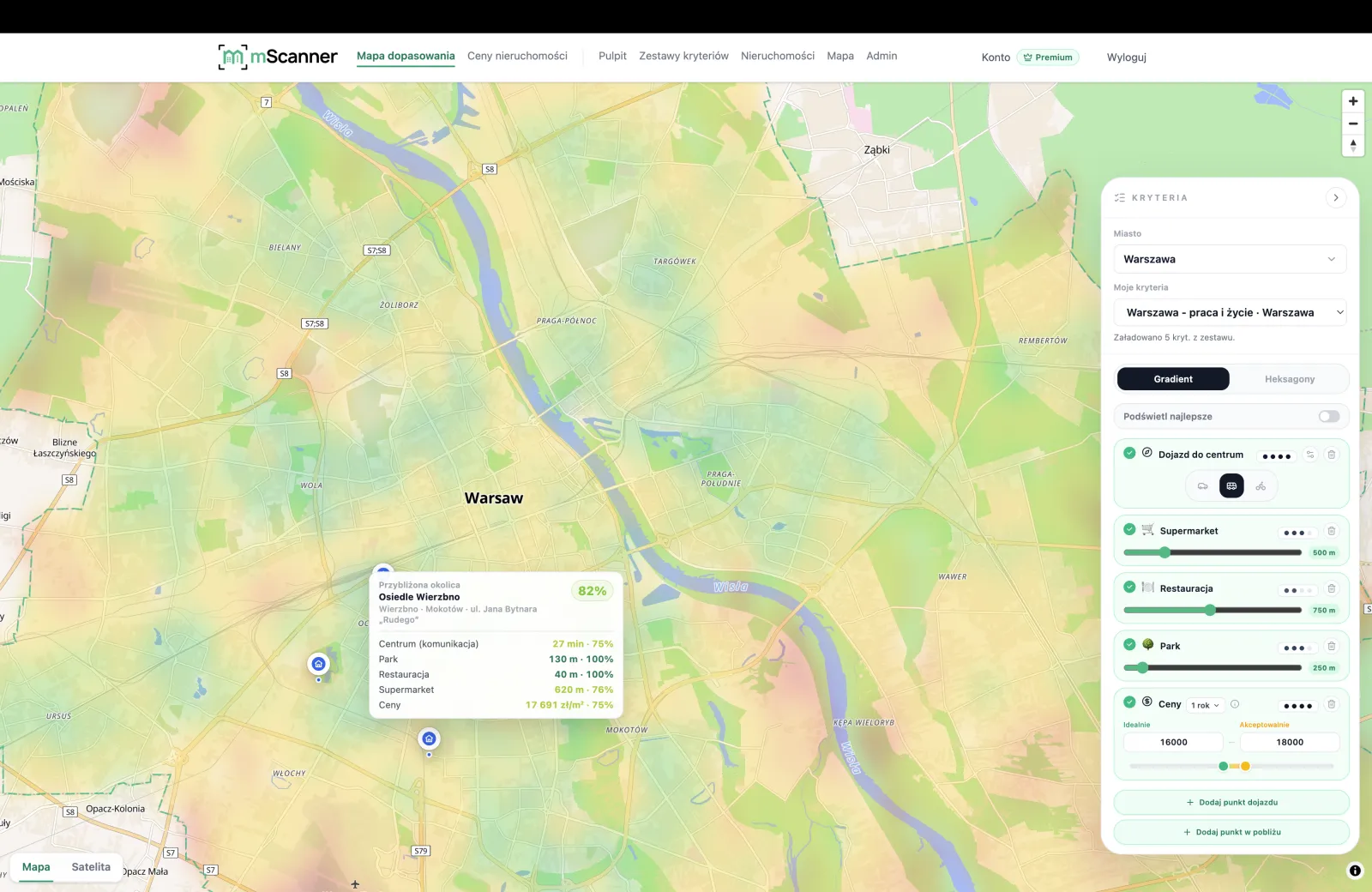
These descriptions are informational — the best district depends on your criteria. Score the district match on the map →
How to choose a location
The question is whether an address fits your day, not only where it's cheaper. mScanner helps analyse a location in Bialystok through concrete criteria, not through a district's general reputation.
First it is worth deciding what matters most to you: the commute, quiet, greenery, schools, services, transport or quick access to the centre.
Local differences in Bialystok
When choosing a flat, compare areas such as Centrum, Sienkiewicza, Bojary, Piaski, Przydworcowe, Antoniuk, Wysoki Stoczek, Dziesięciny, Bacieczki and Białostoczek. Each of them can look different on the commute, services, greenery, noise and price.
Białystok is worth comparing with Wasilków, Choroszcz, Supraśl and Zabłudów. The outskirts can be cheaper and closer to nature, but you have to count the daily bus or car commute.
Commutes
A commute is best measured to specific places, not just to the centre. For one person the best address is near a stop, for another near a good motorway access or a school.
In Białystok the daily commute relies on buses and the car, so how well an estate is connected and the access to the main roads matter — not just the distance to the centre.
Greenery and recreation
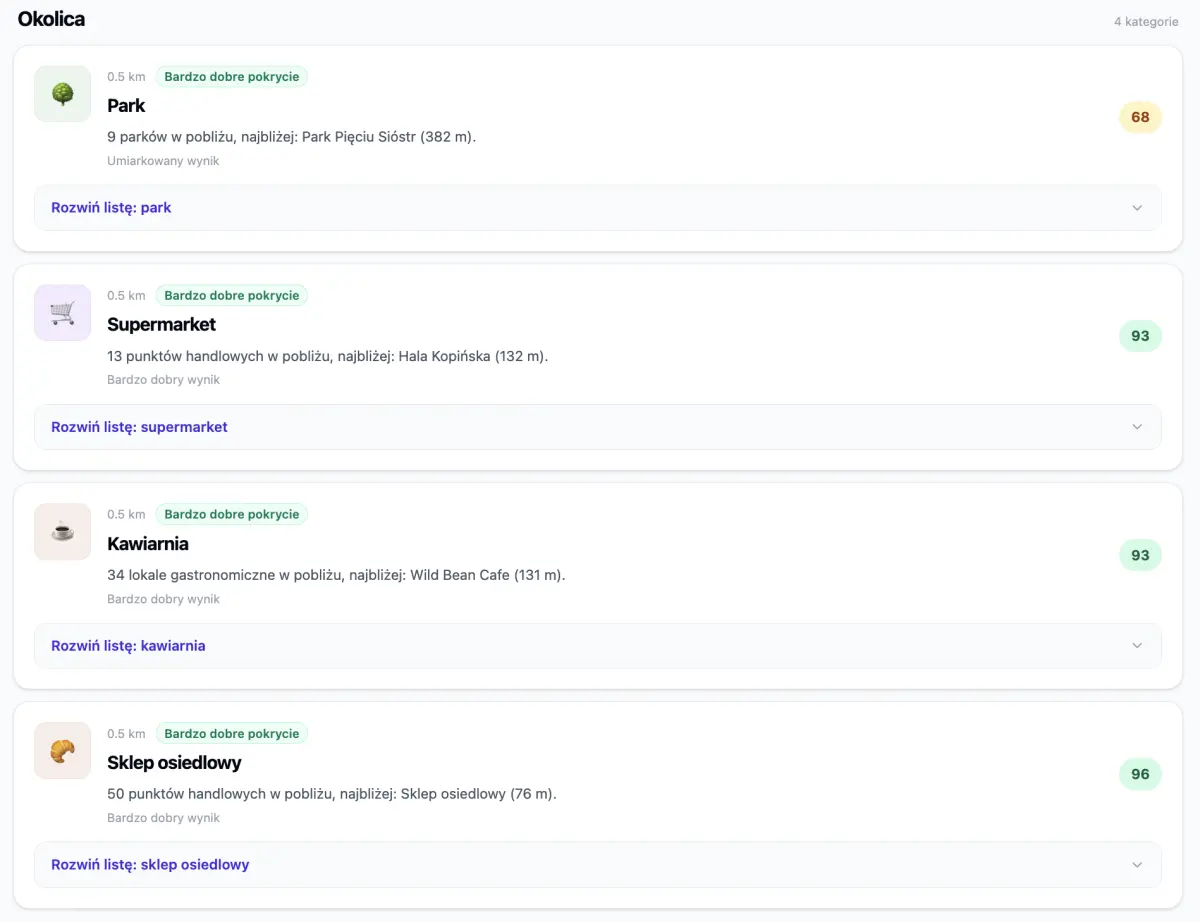
Proximity to greenery affects daily life, but the distance to a park alone is not enough. It is worth checking the real access to walking, waterside and recreation areas.
Nearby services
Shops, nurseries, schools, clinics and everyday service points can save more time than a few minutes saved on the commute to the centre.
Noise and surroundings
Noise, busy streets, proximity to large developments and the character of the buildings are worth assessing before you decide on a flat — whether you are buying or renting.
The zoning plan (MPZP) and the area plan
The local zoning plan (MPZP) and the urban surroundings help you understand what might be built nearby and whether the current view from the window is a lasting feature of the location.
How to use the mScanner city heatmap
In mScanner you can pick location criteria and check which areas best fit your needs. It is then worth setting the result against the price and the report for a specific address.
Frequently asked questions
How does mScanner help choose where to live in Bialystok?
It helps compare specific addresses by commutes, services, greenery, noise, the zoning plan, prices and your own location criteria.
Does mScanner replace viewing a flat?
No. mScanner helps organise the most important questions before deciding, but viewings, documents and professional checks are still needed.
Is it worth comparing several flats at once?
Yes. Comparing several saved flats helps you see whether you are paying extra for a real location advantage or just for the wording of the listing.
Which districts in Bialystok are the greenest?
It depends on how close to a park, forest or water you want to live and which way you travel day to day. Instead of a generic ranking, the mScanner city heatmap scores areas by real access to greenery — set that criterion and see which addresses come out best for you.
Where in Bialystok are the cheaper districts?
The lowest price per m² is not always the best choice — a cheap address can be far from work or services. The price map shows the price distribution, and the city heatmap sets price against the commute and surroundings, so you do not save at the cost of your daily commute.
Where to live in Bialystok for a good commute to work or the centre?
Start with the question: by car or transit, and at what hours? The city heatmap computes the travel time from each area to the points you choose — work, school or the centre — so instead of guessing you see which districts give a fast commute on your routes.
How do I find a quiet, calm district in Bialystok?
Quiet depends on more than the absence of a busy street — proximity to large developments and the building plan matter too. The city heatmap factors in a noise criterion, and the address report shows the zoning plan and surroundings, so you can check whether the calm is lasting.
Which district in Bialystok is best for a family, a single person or a student?
There is no single best district — a family values schools, quiet and greenery, a single person values proximity to the centre and transport, and a student values rent and the commute to campus. In the city heatmap you set the weights of these criteria and get a result tailored to your profile.